La Roche-Posay vs Neutrogena for Acne: Which Is Better for a College Student?
It’s 11 p.m. You’re standing in the drugstore aisle, your exam is in nine hours, and your chin just picked tonight to break out.
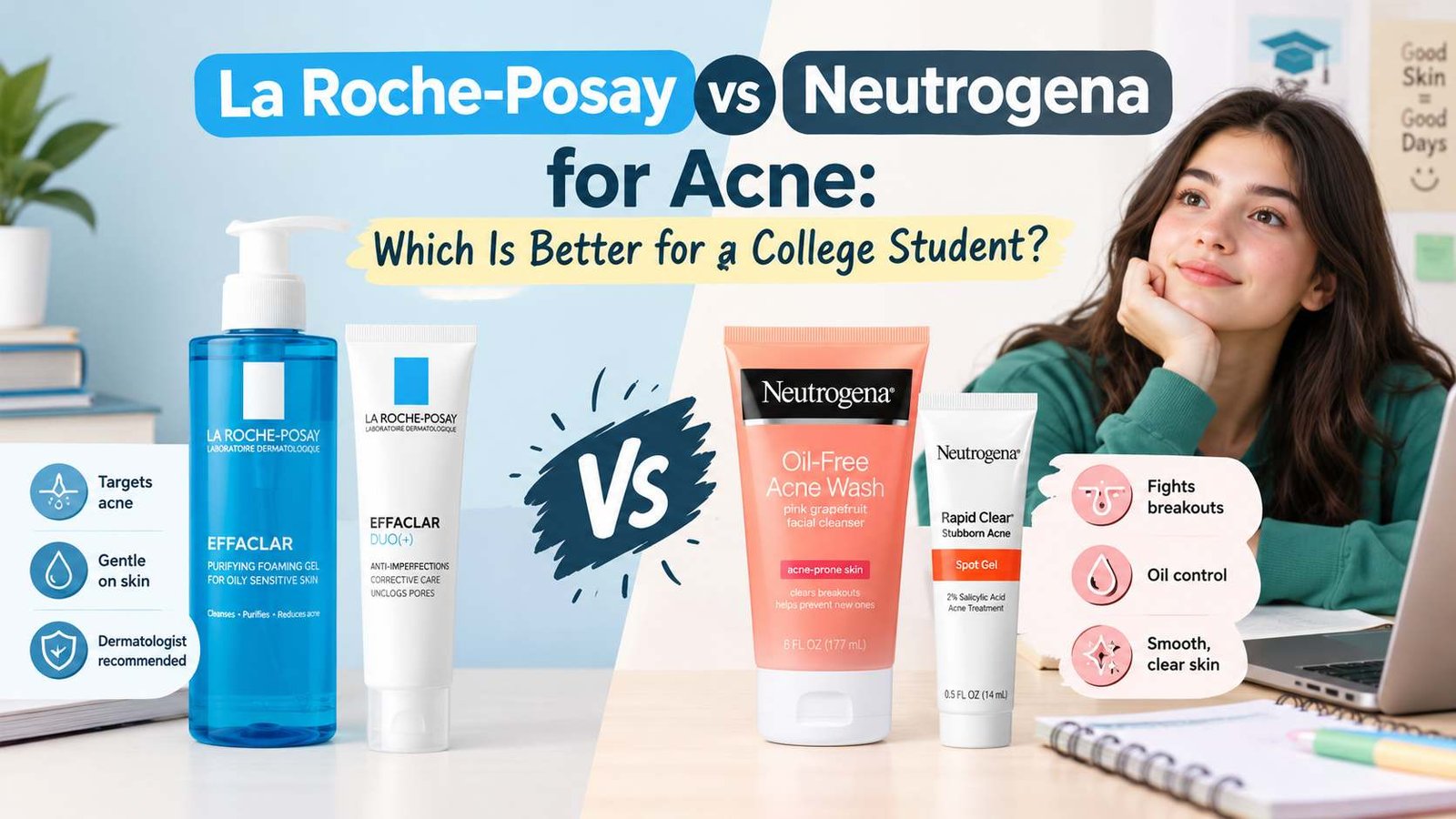
One shelf is Neutrogena: cheap and everywhere. The other is La Roche-Posay: pricier, with a reputation as the dermatologist-approved pick.
So, if you’re a college student with acne-prone skin, are La Roche-Posay products actually better than Neutrogena?
Not across the board. La Roche-Posay is usually worth the money for moisturizer, sunscreen, and sensitive or irritated skin. Neutrogena (or a store brand) often does the job for cleansers and basic treatments if your skin is oily and tolerant.
Below, I compare them product by product, price out a real student routine, and flag the habits that keep acne hanging around.
The Short Answer
- Skin stings, peels, or turns red? Lean La Roche-Posay, especially for cleanser and moisturizer.
- Oily, tolerant skin and a tight budget? Neutrogena or a store brand will usually do the job.
- Not sure? Go hybrid: save on products you rinse off, spend on products that stay on your skin.
No article can tell you which formula your skin will like. But the rest of this one will get you close, fast.
What Actually Treats Acne (Hint: It’s Not the Logo)
Most over-the-counter acne products work through one of three active ingredients. Both brands use them.
Salicylic acid exfoliates inside the pore. It’s the go-to for blackheads, whiteheads, and shiny, congested skin.
Benzoyl peroxide targets acne bacteria and calms red, inflamed pimples. It can dry you out, and it bleaches towels and pillowcases.
Adapalene is a retinoid that helps stop pores from clogging in the first place. It’s good for acne that keeps coming back, but expect some dryness and peeling while your skin adjusts.
Here’s the part brand marketing skips: the same active at the same strength does the same job whether the box says $9 or $30.
What changes is everything else in the formula. Fragrance, alcohol, texture, and soothing ingredients decide whether you can actually use the product every day.
That’s the real La Roche-Posay vs Neutrogena question. It’s less about which brand clears acne and more about which formula your skin tolerates.
La Roche-Posay vs Neutrogena, Product by Product
Comparing brands in the abstract gets you nowhere. Compare the job each product does.
| Job | La Roche-Posay | Neutrogena |
|---|---|---|
| Salicylic acid cleanser | Effaclar Medicated Gel Cleanser | Oil-Free Acne Wash (2% salicylic acid) |
| Gentle cleanser | Toleriane Hydrating Gentle Cleanser | Ultra Gentle Daily Cleanser |
| Benzoyl peroxide treatment | Effaclar Duo Dual Action Acne Treatment | Stubborn Acne line |
| Retinoid | Adapalene Gel | Not a direct match; compare to Differin or a store-brand adapalene |
| Sunscreen | Anthelios | Various sunscreens |
Strengths, sizes, and prices change, so read the Drug Facts box on the box in your hand before you buy.
A few things stand out when you compare labels.
Cleansers are close to a wash. A 2% salicylic acid cleanser from either brand does a similar job. It’s on your face for about 30 seconds before you rinse, so paying extra rarely pays off.
Treatments differ by formula and strength. Effaclar Duo uses benzoyl peroxide (around 5.5%), while Neutrogena’s lineup has several benzoyl peroxide products at different strengths. Compare the percentage and the format before you compare the logo.
Moisturizer and sunscreen are where the formula matters. These sit on your skin all day, so a fragrance-free, barrier-friendly formula makes a real difference when your skin is already irritated.
Which Is Better for Sensitive, Red, or Irritated Acne?
La Roche-Posay usually has the edge here, mostly because many of its products skip fragrance and keep ingredient lists short.
Picture a sophomore who starts adapalene and a salicylic acid wash in the same week. By day four her cheeks are tight, flaky, and burning when she washes.
Her fix isn’t a stronger product. She swaps the wash for a gentle cleanser, adds a basic moisturizer, and uses the adapalene every other night.
If your skin stings or peels, read the label for these irritants:
- Fragrance
- Menthol or peppermint
- Drying alcohols
- Several exfoliating acids layered together
Neutrogena has gentle options too, like its Ultra Gentle line. The label matters more than the brand name, and ‘for sensitive skin’ on the front of a bottle isn’t a guarantee.
Patch test anything new on your jawline for a few nights before putting it on your whole face.
Which Is Better for Oily Skin and Blackheads?
If your skin is oily, tolerant, and mostly dotted with blackheads and whiteheads, Neutrogena or a store brand is a smart place to start.
A salicylic acid wash plus a light moisturizer covers most of what you need. That’s it.
Don’t skip the moisturizer because your face feels greasy. Skin that’s stripped and dehydrated often looks shinier and breaks out more, not less.
Oily skin can still be sensitive. If a ‘strong’ product leaves you tight and red, that’s your cue to dial it back, not push through.
What a Student Routine Really Costs
Most skincare advice ignores your bank account. Here are typical US drugstore price ranges. Prices vary by store and sales, so treat these as ballparks.
| Product | Neutrogena (typical) | La Roche-Posay (typical) |
|---|---|---|
| Acne cleanser | about $9-$12 | about $17-$22 |
| Benzoyl peroxide treatment | about $9-$15 | about $25-$32 |
| Moisturizer | about $10-$18 | about $18-$25 |
| Sunscreen | about $10-$18 | about $20-$40 |
The all-La Roche-Posay route adds up quickly. The all-Neutrogena route is the cheapest. The hybrid sits in between and is the one I’d point most students toward.
The hybrid logic is simple: save on products that wash off, spend on products that stay on.
A $10 salicylic acid cleanser you rinse in 30 seconds does the same job as a pricier one. A moisturizer and sunscreen that don’t irritate your skin are worth paying for, because you’ll actually use them.
One more cost trap: a cheap product that burns your face is a waste of money if you quit using it in week two.
A 4-Minute Dorm Routine for Acne-Prone Skin
You have a shared bathroom and an 8 a.m. class. Keep it short.
Morning (about 90 seconds)
- Rinse with water, or use a gentle cleanser.
- Apply a lightweight moisturizer.
- Finish with broad-spectrum SPF 30 or higher.
Night (about 2 minutes)
- Cleanse. Use your salicylic acid wash if your skin is oily and tolerant, or a gentle cleanser if you’re using a treatment.
- Apply one acne treatment (benzoyl peroxide or adapalene) as a thin layer over the whole acne-prone area, not just on the pimple.
- Moisturize.
Start slow. Use a new treatment every other night for the first couple of weeks.
Add one new product at a time. If you add three and break out, you won’t know which one did it.
And be patient. Acne products usually need several weeks, often six to eight, before you can judge them. Switching every two weeks is the fastest way to never find out what works.
Dorm habits that quietly help
- Keep your products in your own caddy and skip borrowing a roommate’s.
- Change your pillowcase and towel often, especially if you use benzoyl peroxide, which bleaches fabric.
- Wash your face after workouts instead of letting sweat sit.
- Wipe your phone screen. It spends a lot of time against your cheek.
Don’t Forget the Marks Pimples Leave Behind
For many students, the dark spots bother them more than the pimples. These marks are called post-inflammatory hyperpigmentation.
They can last months, and they tend to be more noticeable and slower to fade on deeper skin tones. Irritation and picking make them worse.
That’s one more reason to choose a formula your skin tolerates. A harsh routine that leaves you inflamed can trade a few pimples for weeks of dark spots.
Sunscreen matters here too. Sun exposure can darken marks, so daily SPF is part of treating them.
Neither brand will fix true scars, like indented or raised ones. Those are a job for a dermatologist.
Can You Mix La Roche-Posay and Neutrogena?
Yes. Brands aren’t ecosystems, and nothing in one will ‘reject’ the other.
A common student combo is a Neutrogena or store-brand cleanser with a La Roche-Posay moisturizer and sunscreen.
Just follow these rules:
- Introduce one new product at a time.
- Don’t stack benzoyl peroxide, a retinoid, and an exfoliating acid on the same night.
- Use sunscreen every morning. Acne treatments can make skin more sun-sensitive.
Mistakes That Keep Acne Around
Scrubbing harder. Rough scrubs irritate inflamed skin. The American Academy of Dermatology advises washing gently and skipping the scrubbing.
Skipping moisturizer. Dry, stripped skin gets irritated, and irritated skin is harder to treat.
Spot-treating only. Treatments like adapalene work best across the whole acne-prone area, not only on the pimple you already have.
Picking. It’s the fastest way to get dark marks and scars.
Assuming expensive means stronger. Price tells you about packaging and formula, not about how strong the active is.
When to Skip Both and See a Dermatologist
Drugstore products have limits. Book an appointment if you have:
- Deep, painful bumps or cysts
- Acne that’s leaving scars or lasting dark marks
- Breakouts that keep worsening after weeks of consistent use
- A rash or bumps you aren’t sure are acne
Check your campus health center first. Many offer dermatology visits or referrals, which can cost less than guessing your way through the drugstore.
If you’re pregnant or might be, ask a doctor before using retinoids such as adapalene.
This article is general information, not medical advice.
FAQ
Is La Roche-Posay better than Neutrogena for acne?
It depends on your skin. La Roche-Posay tends to suit sensitive or irritated skin, while Neutrogena works well for oily, tolerant skin on a budget.
Is La Roche-Posay worth the price?
It’s often worth it for moisturizer and sunscreen. For cleansers you rinse off, a cheaper option usually does the same job.
Is Neutrogena too harsh for acne-prone skin?
Some formulas are drying, and others are gentle. Judge the specific product by its ingredients and how your skin reacts.
Which should a beginner start with?
Start simple: a gentle cleanser, a moisturizer, sunscreen, and one acne treatment. Pick the brand that fits your budget and your skin’s tolerance.
Can I use both brands together?
Yes. Just add one new product at a time and avoid stacking several strong actives in one night.
How long until I see results?
Give a new routine several weeks. Many people need six to eight before they can judge it fairly.
Does a more expensive acne product work better?
Not automatically. A pricey product isn’t stronger just because of its price. Compare the active ingredient and its strength.
The Bottom Line
La Roche-Posay isn’t automatically better than Neutrogena for acne. It earns its price on moisturizer, sunscreen, and sensitive or irritated skin.
Neutrogena and store brands are hard to beat on cleansers and basic treatments for oily, tolerant skin.
For most students, a hybrid routine gets the best of both: cheap where it washes off, gentler where it stays on. Start with one change, give it a few weeks, and see a dermatologist if acne gets painful or leaves marks.