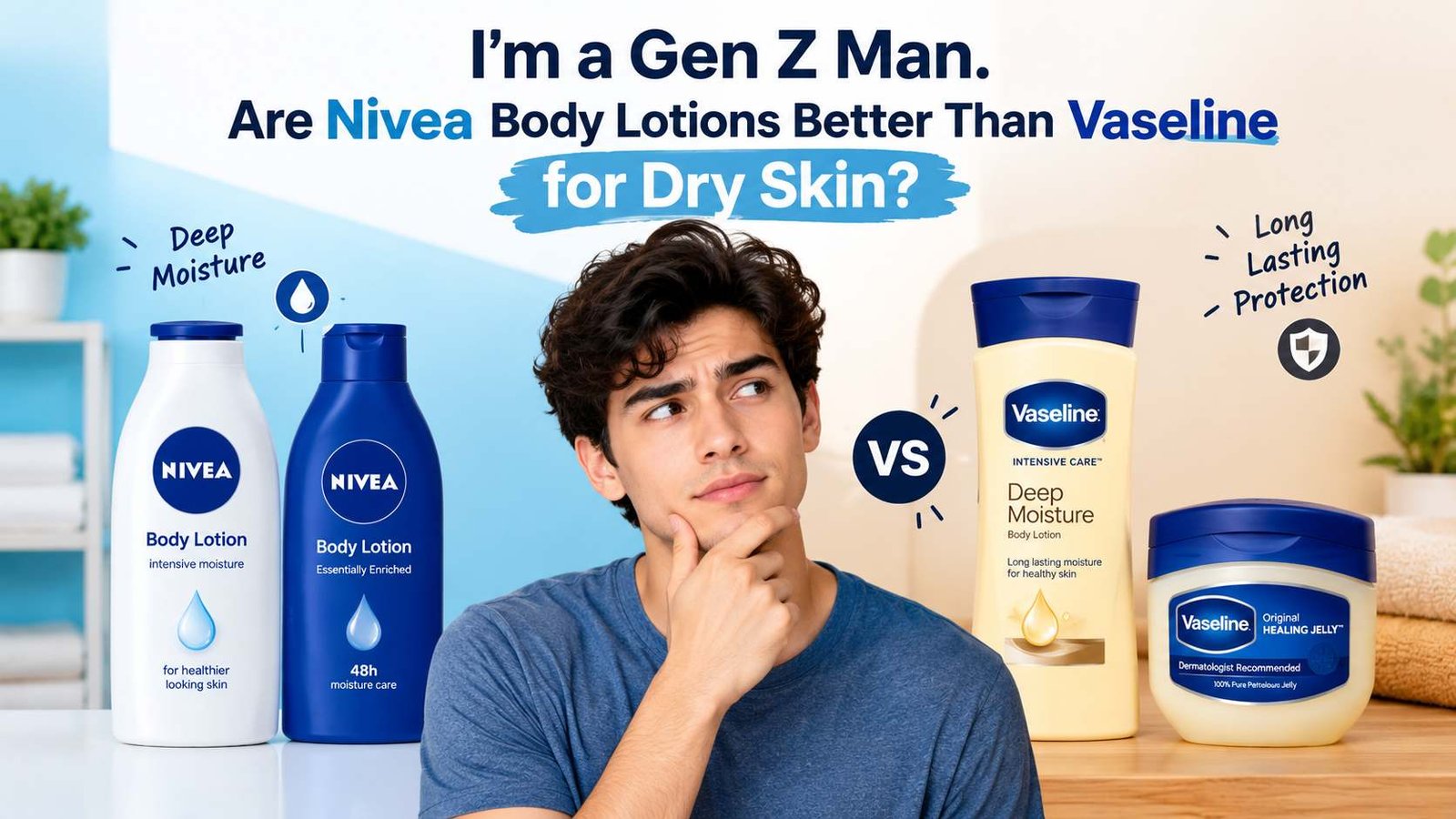
I’m a Gen Z Man. Are Nivea Body Lotions Better Than Vaseline for Dry Skin?
You step out of a hot shower, towel off, and your shins feel like sandpaper.
Now you’re staring at two bottles. Nivea or Vaseline?
Here’s the straight answer, then the proof.
So, Is Nivea Better Than Vaseline for Dry Skin? (The Short Answer)
No. Neither brand wins on its name alone.
The specific bottle you grab and the kind of dryness you have decide the winner. A light Nivea can beat a rich Vaseline, and the reverse is just as true.
Use this quick pick to start:
| Your situation | Start with | Why |
|---|---|---|
| Mild dryness, you hate sticky skin | A lightweight daily lotion, such as Nivea Express Hydration | Easy to keep using every day |
| Very dry, rough or flaky | A richer lotion, such as Nivea Essentially Enriched or Vaseline Intensive Care Advanced Repair | Made for dry to very dry skin |
| Itchy or easily irritated | A fragrance-free lotion, such as Vaseline Advanced Repair Unscented | Fewer things to react to |
| Rough elbows, knees, heels | Any lotion, then plain petroleum jelly on those spots | Lotion adds water, jelly slows its escape |
| After the gym | Whichever one you’ll actually apply within minutes of showering | Timing beats brand |
Product names and formulas change by country, so check the label on the bottle in your hand.
Why Gen Z Guys Get Dry Skin (It’s Not Just Winter)
Dry skin rarely comes from one bad habit. It comes from the stack.
Picture a normal day. You hit the gym, take a long hot shower because it feels great, and scrub with a strong body wash to kill the gym smell.
Then you sit in an air-conditioned lecture hall or office for six hours. Then you shave.
Every step strips a little oil from your skin. Add them up and your shins, forearms and hands pay the bill.
Lotion vs Cream vs Jelly: What You’re Actually Comparing
Before you pick a brand, know what’s in the bottle. Moisturizers do three jobs:
- Humectants (glycerin, hyaluronic acid) pull water into the skin.
- Emollients (shea butter, plant oils) smooth rough texture.
- Occlusives (petrolatum, mineral oil) slow water from escaping.
Most good lotions mix all three.
Here’s the mix-up that trips people up: Vaseline lotion is not Vaseline jelly.
Jelly is basically an occlusive. It seals in water that’s already there but doesn’t add any. A lotion contains water and humectants, so it does both jobs.
That makes the popular line “Nivea hydrates, Vaseline locks it in” too simple. Many lotions from both brands pair glycerin with petrolatum. Read the ingredient list instead of trusting the logo.
Think of it as a ladder:
- Lotion for mild to moderate dryness.
- Cream for rough, tight patches.
- Jelly as a thin seal over damp skin on your worst spots.
Nivea vs Vaseline Head to Head
Lineups vary by country, so treat these as examples, not a shopping list.
| Need | Nivea example | Vaseline example |
|---|---|---|
| Light daily use | Express Hydration | Aloe Fresh |
| Rich, for dry to very dry skin | Essentially Enriched | Intensive Care Advanced Repair |
| Fragrance-free | Check for a sensitive-skin option in your market | Advanced Repair Unscented |
Hydration and staying power
Staying power depends on how much sealing power the formula has, not on which brand made it.
Here’s a simple check. Apply lotion after your shower, then notice when your skin feels tight again.
If it’s tight by lunchtime, move up the ladder to a richer lotion. Don’t just swap brands and hope.
Texture and absorption
Both brands sell light and rich versions, so “Nivea is light and Vaseline is heavy” falls apart fast.
Test it on one shin. Rub in a small amount and wait five minutes before getting dressed.
If it pills, leaves residue on your jeans or makes you want to wash it off, it’s the wrong bottle for you.
Scent: fragrance-free vs unscented
These aren’t the same thing. “Unscented” can still include ingredients that mask odor. “Fragrance-free” means no fragrance was added.
If your skin itches or stings, look for the words “fragrance-free” on the label.
If you wear cologne, a scented lotion competes with it. Fragrance-free keeps things clean.
Sensitive or itchy skin
Burning, stinging, redness or worse itch after applying means stop using it.
Patch test first. Put a small amount on your inner arm for a few days before covering your whole body.
Change one product at a time. If you start a new body wash, a scrub and a lotion in the same week, you won’t know which one caused the problem.
Price per ml and how long a bottle lasts
Ignore the sticker price. Divide price by millilitres.
Example with made-up numbers: an $8 bottle with 400 ml costs 2 cents per ml. A $6 bottle with 250 ml costs 2.4 cents per ml. The “cheaper” bottle is the pricier one.
Run this math with your local prices. A thin, even layer also makes any bottle last longer.
The Gen Z Reality Check
Most lotion guides ignore how you actually live. Here’s what matters.
- Gym grip: Slippery palms on a barbell or pull-up bar can ruin a set. Skip your palms before lifting and moisturize after your post-workout shower instead.
- Cologne clash: Scented lotion, deodorant and cologne make three smells fighting each other. Go fragrance-free on your body and let the cologne do its job.
- Clothes and sheets: Rich lotions and jelly can leave marks. Wait a few minutes before dressing, and keep jelly for small spots at night.
- After shaving: If lotion stings on freshly shaved skin, switch to a fragrance-free one.
- Shared bathroom or dorm: Keep a small bottle in your gym bag. Apply in the changing room while your skin is still damp.
Summer, Winter and Air Conditioning
Hot and humid: Use a thinner layer of a lighter lotion. A heavy layer feels like wearing a wet jacket.
Cold and dry: Move to a richer lotion and add a thin layer of jelly on cracked or rough spots at night.
AC office or hostel: AC dries the air even in summer. Keep a small bottle at your desk for your hands.
Daily gym: Moisturize right after every shower. Make it automatic.
When Neither One Is the Answer
Sometimes the problem isn’t dryness, and a different brand won’t fix it.
Rough little bumps on your upper arms. This is often keratosis pilaris. Moisturizer alone usually doesn’t smooth it. Ask a pharmacist or dermatologist about lotions with urea or lactic acid.
Breakouts on your chest or back. Heavy products can make body acne worse for some people. Look for products labelled non-comedogenic, and stop if breakouts get worse. For more on acne-prone skin, see our guide to skincare for acne-prone skin.
Signs you should see a doctor:
- Cracks that bleed
- Swelling, warmth or oozing
- Severe itch that disrupts your sleep
- Widespread scaling
- No improvement after a week of consistent moisturizing
Those can point to eczema, dermatitis or a fungal problem. This article can’t diagnose you, but a clinician can.
Try This 7-Day Split-Leg Test
Stop guessing. Test both bottles on your own body.
- After the same shower each day, apply Nivea to one lower leg and Vaseline to the other.
- Use roughly equal amounts.
- Don’t add jelly or oil during the test.
- Check tightness, flaking and itch two hours later and again before bed.
- Do this for seven days, then keep the side that felt best.
Write it down so you’re not relying on memory:
| Day | Tightness (0 to 5) | Flaking | Itch | Notes |
|---|---|---|---|---|
| 1 | ||||
| 4 | ||||
| 7 |
Take a photo of each leg on days 1 and 7 in the same lighting.
The test has limits. It’s one person in one week and one climate. But it beats a brand’s marketing, and it’s free.
Stop right away if either leg burns or breaks out in a rash.
A Simple 4-Step Routine That Works
- Take a lukewarm shower. Hot water strips more oil. Keep it short.
- Pat dry. Leave your skin slightly damp, not dripping.
- Apply lotion within a few minutes. This traps the water already on your skin.
- Seal rough spots at night. Add a thin layer of petroleum jelly to elbows, knees or heels.
Reapply to your hands after washing them. They lose moisture fastest.
Final Verdict: Which One Should You Buy?
Pick by situation, not by logo:
- If your skin is mildly dry and you hate stickiness, buy the lightest lotion you can find from either brand.
- If your skin is very dry or rough, buy the richer lotion and add jelly on the worst patches.
- If your skin itches or stings, start with a fragrance-free lotion.
- If you’re not sure, run the split-leg test.
The habit that matters most is simple: apply lotion to damp skin, every day.
FAQs
Is Vaseline lotion the same as petroleum jelly?
No. Vaseline lotion contains water, humectants and conditioning ingredients. Vaseline jelly is mostly petroleum jelly, an occlusive that seals moisture in but doesn’t add water. Many people use lotion first and jelly on top for rough spots.
Can I use Nivea and Vaseline together?
Yes. Apply a lotion to slightly damp skin, then add a thin layer of plain petroleum jelly only where skin is roughest, like elbows, knees or heels. Covering your whole body in jelly can feel heavy and may stain clothes.
Which is better after the gym?
Whichever you’ll apply right after a lukewarm shower. A lighter lotion is easier under clothes. Keep a small bottle in your gym bag so you can moisturize while your skin is still damp.
Do men need a “men’s” body lotion?
No. Dry skin needs the same things regardless of the label. What matters is the formula, the scent and the texture you’ll actually use. Choose on ingredients and feel, not on whether the bottle says “men.”
How often should I apply body lotion?
Apply it after every shower and any time your skin feels tight. Hands may need more frequent reapplication after washing. Very dry areas can take a second layer at night.
Is Vaseline jelly okay to use all over the body?
It can work, but it’s heavy. Most people prefer jelly on small rough areas and lotion everywhere else. Some people find a thick layer on the chest or back can worsen breakouts.
Can I use body lotion on my face?
It’s better not to. Facial skin is often more prone to clogged pores, and rich body formulas can feel greasy or contribute to breakouts. Use a facial moisturizer labelled non-comedogenic instead.
Which is better for ashy skin?
Ashiness is surface dryness, and it can show more on darker skin tones. Either brand’s richer lotion can help. Apply it to damp skin within minutes of showering, and try a thin seal of jelly on stubborn patches.