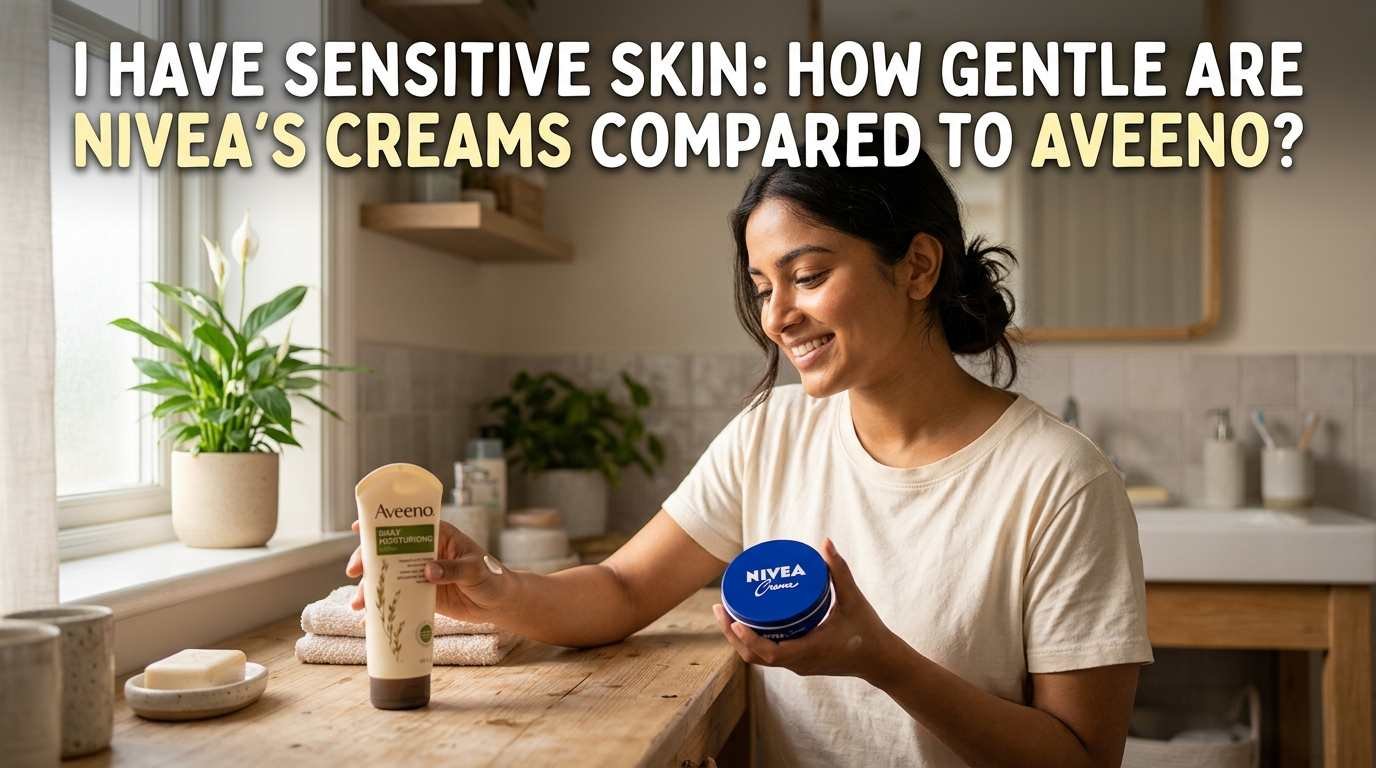
I Have Sensitive Skin: How Gentle Are Nivea’s Creams Compared to Aveeno?
You buy a new cream. It feels amazing for three days.
Then your cheeks turn red, and the itching starts.
If that’s you, you’re probably asking the same thing everyone with reactive skin asks: how gentle are Nivea’s creams compared to Aveeno?
The short answer: Aveeno is usually the safer first try. But the brand name isn’t what decides it. The exact product in your hand is.
Below, I’ll break down what’s inside each brand’s most popular creams, what tends to irritate, and how to test a new one without wrecking your skin.
The Short Answer: Is Nivea or Aveeno Gentler for Sensitive Skin?
Aveeno is usually gentler. More of its lotions are fragrance-free, and many are built around oats, which are known for calming itchy, dry skin.
Nivea can still work. Many people use it for years with zero issues. But the classic blue tin, NIVEA Creme, lists both fragrance and lanolin alcohol on its label. Both can bother reactive skin.
And here’s the twist most comparisons skip: Nivea also sells a fragrance-free lotion, and not every Aveeno product is fragrance-free.
Pick Nivea if:
- Your skin is dry but handles scented products fine
- You want a rich, thick cream for hands, elbows, and knees
- Budget matters and you want something easy to find
Pick Aveeno if:
- Your skin stings, flushes, or itches easily
- Scented products have bothered you before
- You have dry, eczema-prone skin and want oat-based care
Nivea vs Aveeno at a Glance
| Nivea | Aveeno | |
|---|---|---|
| Fragrance-free options | Yes, but not the classic tin | Yes, in many lines |
| Oat-based formulas | Few | Many |
| Thick cream for very dry skin | NIVEA Creme | Skin Relief, Eczema Therapy |
| Light everyday lotion | Yes | Yes |
| Best for | Dry skin that tolerates scent | Reactive, dry, or eczema-prone skin |
Both brands sell dozens of products, and they don’t all behave the same. Treat this table as a starting point, then read the sections below.
What “Gentle” Actually Means for Sensitive Skin
Sensitive skin isn’t a medical diagnosis. It’s a description: skin that stings, itches, burns, or turns red more easily than most.
Cold wind can trigger it. So can hot showers, harsh cleansers, and scratchy fabric.
The usual culprit is a worn-down skin barrier. That’s the outer layer that keeps water in and irritants out. When it’s weak, even a mild cream can sting.
It also helps to know there are two types of reactions:
- Irritant reactions show up fast. The product directly bothers your skin surface, and you feel it within minutes or hours.
- Allergic reactions are slower. Your immune system reacts to one specific ingredient, and the rash can take days to appear.
This matters because a cream can feel fine on day one and still cause an allergic reaction by day four. That’s why the patch test later in this post runs for a week or more.
Nivea Creams: What’s Inside and What Might Irritate You
Nivea is made by Beiersdorf, a German company. It sells many moisturizers, and the differences between them are big.
NIVEA Creme (the classic blue tin)
The current US label starts with water, mineral oil, petrolatum, and glycerin. It also lists lanolin alcohol, panthenol, and fragrance.
Here’s what those do:
- Mineral oil and petrolatum seal in moisture.
- Glycerin pulls water into the skin.
- Panthenol (a form of vitamin B5) helps soothe dryness.
Two ingredients cause most complaints: fragrance and lanolin alcohol. Lanolin alcohol can trigger people who are allergic to lanolin.
The cream is also thick. That’s great on rough elbows and heels, but it can feel heavy on your face.
A quick note for readers outside the US: ingredient lists vary by country. UK and EU labels name individual fragrance allergens like limonene and linalool, while the US label just says “fragrance.” Always check the label on the jar you’re actually buying.
NIVEA Soft
This is a lighter cream you can use on face, body, and hands. It has glycerin, mineral oil, jojoba oil, and vitamin E. It also contains fragrance. Formulas differ by country.
Nivea’s fragrance-free lotion
Nivea’s Sensitive & Radiant Body Lotion is made for dry, sensitive skin and contains no fragrance. It includes glycerin, petrolatum, and panthenol.
If you like Nivea and want to stay with the brand, start here instead of the blue tin.
Aveeno Creams: What’s Inside and Where It Falls Short
Aveeno is made by Kenvue and built around oats. You’ll see “dermatologist recommended” on a lot of packaging.
Treat that as marketing. Read the ingredient list anyway.
The oat advantage
Colloidal oatmeal is oat ground into a very fine powder. It coats the skin, helps it hold water, and eases itching.
The FDA recognizes colloidal oatmeal as a skin protectant ingredient in over-the-counter products. Oats also contain compounds called avenanthramides, which researchers have studied for calming irritation.
Daily Moisturizing Lotion
The fragrance-free version lists water, glycerin, petrolatum, oat kernel flour, cetyl alcohol, dimethicone, and benzyl alcohol, among others.
It’s a light, everyday option and a solid first pick for reactive skin.
Skin Relief and Eczema Therapy
Skin Relief Moisturizing Lotion uses a triple oat blend and shea butter, with no fragrance. It’s aimed at very dry, sensitive skin.
Eczema Therapy Daily Moisturizing Cream pairs colloidal oatmeal with ceramides, which are fats your skin barrier naturally contains.
Where Aveeno can let you down
No brand is perfect, and this is the part most articles skip:
- Not every Aveeno product is fragrance-free. Check each box.
- Oat allergy is rare, but it happens.
- Benzyl alcohol is a preservative. It keeps lotion free of bacteria, but a small number of people react to preservatives. Very reactive skin still needs a test.
- Some users report stinging despite the “sensitive skin” label. It’s a pattern in reviews, not a prediction for you.
Fragrance-Free vs. Unscented: The Label Trap
These two words sound identical. They’re not.
The American Academy of Dermatology advises choosing products labeled fragrance-free if scent bothers your skin. “Unscented” and “plant-based” products can still contain fragrance-related ingredients.
Here’s the fix: look for the words fragrance-free on the front. Then scan the ingredient list for fragrance, parfum, or perfume.
Also, don’t lean on the front-of-pack claims. The FDA says terms like “hypoallergenic” and “for sensitive skin” have no single federal definition for cosmetics. Natural or “clean” products can cause reactions too.
The ingredient list tells you more than the front label ever will.
Ingredient Cheat Sheet
Labels read like a chemistry exam. Here’s what the main names mean:
| Ingredient | What it does | Where you’ll see it |
|---|---|---|
| Glycerin | Humectant: pulls water into skin | Both brands |
| Petrolatum | Occlusive: slows water loss | NIVEA Creme, Aveeno Daily Moisturizing |
| Mineral oil | Occlusive and emollient | NIVEA Creme, NIVEA Soft |
| Panthenol | Soothes dry skin (vitamin B5) | Nivea products |
| Colloidal oatmeal / oat flour | Protects skin, eases itch | Aveeno |
| Ceramides | Support the skin barrier | Aveeno Eczema Therapy |
| Lanolin alcohol | Softens, but a possible allergen | NIVEA Creme |
| Fragrance | Adds scent, a common trigger | NIVEA Creme, NIVEA Soft |
Quick vocabulary: a humectant draws water in. An occlusive seals it there. An emollient smooths rough skin. A good moisturizer uses all three.
Ingredients that rarely cause trouble include glycerin, petrolatum, panthenol, and shea butter. But any ingredient can bother any one person.
Nivea vs Aveeno by Skin Type and Trigger
“Sensitive” means different things to different people. Here’s how to match your situation to a product:
Your skin stings or flushes with scented products. Start with Aveeno Daily Moisturizing Lotion (the fragrance-free version) or Nivea’s fragrance-free lotion. Skip the blue tin.
Your skin is very dry, rough, or eczema-prone. Aveeno Skin Relief or Eczema Therapy is a common first pick. If eczema is ongoing, let a dermatologist guide your routine.
You’re allergic to lanolin. Avoid NIVEA Creme, since lanolin alcohol is on the label. Check any other product you consider.
You get dry patches but scent has never bothered you. NIVEA Creme can be great for hands, elbows, and knees.
Your skin is sensitive and breakout-prone. Choose a light, fragrance-free lotion over a thick tin. Heavy creams can feel greasy on oily skin.
Face vs. Body: Can You Use These Creams on Your Face?
Often you can, but not always with the same product.
Creams contain more oil than lotions, so they hold in water longer. The AAD generally recommends creams or ointments for very dry, eczema-prone skin.
But on your face, lighter is usually better. A thick body cream can feel greasy, and it may clog pores if you’re oily or breakout-prone.
This is why some people ask, “Why does my face burn after using Nivea cream?” Common causes include:
- Fragrance
- A lanolin allergy
- A damaged skin barrier
- A cream that’s simply too heavy for your face
If it burns, wash it off and stop using it. If the redness or burning lasts, see a dermatologist.
A simple split many people use: a cream at night, a lotion during the day.
Price and Value: Which Is Easier on Your Budget?
Nivea is generally easy to find and affordable. Aveeno often costs a bit more, though prices vary by product, size, and store.
Don’t compare sticker prices. Compare price per ounce.
Here’s the math with made-up numbers: a 5 oz bottle at $8 costs $1.60 per ounce. An 18 oz bottle at $14 costs about $0.78 per ounce. The bigger bottle wins, if your skin tolerates it.
And remember: a cheap cream that irritates your skin costs more in the end. You pay for the jar, then for the repair.
Buy the smallest size first. Patch test it. Upgrade to the big bottle once it passes.
How to Patch Test a New Moisturizer (7 to 10 Days)
The AAD recommends testing a new product before using it everywhere. Here’s the routine:
- Pick a spot about the size of a quarter, like your inner forearm.
- Apply the product to that spot twice a day.
- Use your normal amount and leave it on as long as you usually would.
- Watch for redness, itching, or swelling for 7 to 10 days.
- If skin reacts, wash it off and stop using it.
Test one product at a time. If you try two, you won’t know which one caused the problem.
A cool compress can soothe a mild reaction. Get medical care if swelling spreads or a rash lasts.
[AUTHOR NOTE: Add your own patch-test photos and day-by-day notes here if you run one. First-hand results are the strongest way to make this post stand out from competitors.]
Common Mistakes When Choosing a Cream for Sensitive Skin
Buying by the front label. Flip the jar over and read the ingredients.
Starting three new products in one week. If something stings, you can’t tell which one did it.
Using a thick hand cream on the face. Different skin, different needs.
Pushing through the sting. If it burns every time, stop.
Moisturizing on bone-dry skin. Dermatologists often advise applying moisturizer while skin is still slightly damp, since it helps hold in water.
Quick Picks: Which Product Should You Start With?
| Your situation | Start with |
|---|---|
| Stings or flushes with scented products | Aveeno Daily Moisturizing Lotion (fragrance-free) |
| Very dry, rough, or eczema-prone skin | Aveeno Skin Relief or Eczema Therapy Cream |
| Dry hands, elbows, knees; scent is fine | NIVEA Creme |
| You prefer Nivea but want no scent | Nivea Sensitive & Radiant Body Lotion |
| Oily or breakout-prone face | A light lotion, not a thick tin |
Final Verdict
If your skin turns red or itchy easily, Aveeno is the safer bet most of the time. Many of its lotions have no scent, and the oats help calm skin.
Classic NIVEA Creme is a different story. It contains fragrance and lanolin alcohol, and those two can set off reactive skin.
But Nivea also makes a fragrance-free lotion, and some Aveeno products do contain scent. So don’t choose by brand.
Read the exact label. Patch test for 7 to 10 days. Add one product at a time.
Start with the small bottle. Your skin will tell you what it likes.
This guide is general information, not medical advice. Formulas change often, so always check the label on the product you’re buying. See a dermatologist if you get burning, swelling, or a rash that keeps coming back.
Frequently Asked Questions
Is Aveeno better than Nivea for sensitive skin?
Usually, yes. Aveeno has more fragrance-free, oat-based products. But many people use Nivea without problems, so your own tolerance decides.
Does NIVEA Creme contain fragrance?
Yes. The current US label lists fragrance and lanolin alcohol. Nivea’s fragrance-free lotions are separate products.
Why does my face burn after using Nivea cream?
Fragrance, a lanolin allergy, a weak skin barrier, or a cream that’s too heavy are common causes. Wash it off and stop using it. See a dermatologist if burning or redness lasts.
Is Aveeno really fragrance-free?
Some products are, and the label says so. Not every Aveeno product is, so check each box.
Which is better for dry, sensitive skin?
Both can work. Aveeno often has a slight edge because many of its products combine moisture with soothing oat ingredients.
Which is better for eczema-prone skin?
Aveeno Eczema Therapy contains colloidal oatmeal, and some formulas add ceramides, which makes it a common first pick. If eczema is ongoing, a dermatologist should guide your care.
Can I use Nivea and Aveeno together?
You can, but you rarely need both. Use one at a time so you can see how your skin reacts.
Is fragrance-free always better?
Not for everyone. Some people use scented creams without trouble. If scent has bothered your skin before, choose fragrance-free.