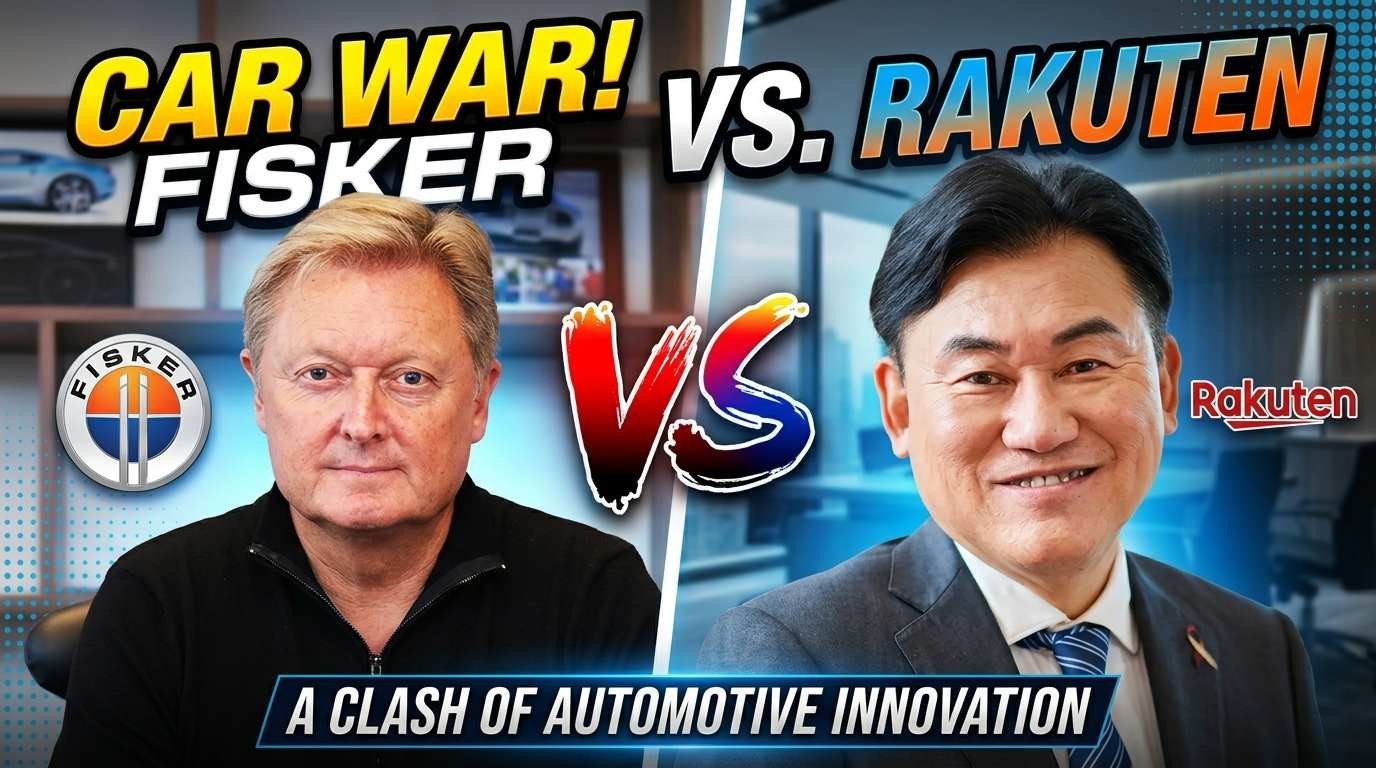
Hiroshi Mikitani and Henrik Fisker: The Real Connection Behind the Search
There’s no documented business relationship between Hiroshi Mikitani and Henrik Fisker.
They never co-founded a company. Mikitani never invested in Fisker Inc., and Fisker never worked at Rakuten.
No public record shows a joint venture, a shared board seat, or a deal between them.
If you came here looking for a hidden partnership, that’s your answer.
Still, the pairing teaches more than you might expect.
Put these two founders side by side and you get one of the clearest contrasts in modern business: a platform builder who kept adding connected services for nearly three decades, and a product visionary who tried twice to turn world-class car design into a lasting car company.
Let’s dig into what that contrast reveals.
Read Also: Jameliz Smith Biography: Real Name, Age, Rise to Fame, and What’s Actually Confirmed
Why People Search “Hiroshi Mikitani and Henrik Fisker” Together
When two famous names show up side by side in search, most people assume a connection exists. That’s a fair instinct, but here the explanation is simpler.
First, paired-name articles are everywhere. Many publishers now pair well-known people in comparison pieces. Readers see those headlines, get curious, and search the pairing themselves. That loop keeps the phrase alive.
Second, both men fit the same research bucket. If you’re studying global founders, founder-led companies, or tech disruption, both names will come up in the same session.
Third, there’s a Japan link in Fisker’s story, just not Mikitani. In early 2024, Nissan held talks to invest in Fisker Inc. Those talks collapsed. Nissan and Rakuten are completely separate companies, but a “Japanese company plus Fisker” headline can easily blur in people’s memories.
Fourth, both built companies that carry big personal brands. Rakuten is hard to picture without Mikitani. Fisker’s companies literally used his name. That makes both men natural case studies in founder identity.
So the search is real, but the relationship isn’t. The comparison is where the value lives.
Frank Sinatra and Kendall Jenner: Why Their Names Are Linked

Who Is Hiroshi Mikitani?
Hiroshi “Mickey” Mikitani was born in Kobe, Japan, in 1965. He studied at Hitotsubashi University, joined the Industrial Bank of Japan in 1988, and earned his MBA from Harvard Business School in 1993.
Harvard changed how he saw entrepreneurship. In the U.S., founders had status. In Japan’s corporate world at the time, leaving a prestigious bank to start a company looked reckless.
Then came the 1995 Great Hanshin earthquake. It devastated his hometown and killed relatives and friends. Mikitani has said the disaster pushed him to stop waiting and start building something that could help revive Japan’s economy.
In 1997, he launched Rakuten Ichiba, an online marketplace that opened with only a handful of merchants. Nearly 30 years later, he still leads Rakuten Group as chairman and CEO.
Who Is Henrik Fisker?
Henrik Fisker was born in Allerød, Denmark, in 1963. He trained in transportation design at ArtCenter College of Design and joined BMW in 1989.
At BMW, he shaped the Z8, the silver roadster that appeared in the 1999 Bond film The World Is Not Enough. He later became design director at Aston Martin, where his name became tied to the DB9 and V8 Vantage.
That’s a résumé most car designers would envy for an entire career. Fisker built it before he turned 45.
Then he chose the harder path. He left the safety of big automakers, started Fisker Coachbuild in 2005, and co-founded Fisker Automotive in 2007. Later, he co-founded Fisker Inc. with his wife, Geeta Gupta-Fisker, in 2016.
Both car companies ended in bankruptcy. His design legacy, though, still stands on its own.
Tiger Woods and Bill Ackman: The Real Nike Connection, Fact vs. Speculation
Platform vs. Product: Two Completely Different Business Models
Here’s the core difference. Mikitani built a system. Fisker built products.
How Mikitani built the Rakuten ecosystem
Rakuten started as a marketplace, but Mikitani made an early decision that shaped everything. Instead of competing with merchants, Rakuten gave them a storefront and charged a low flat monthly fee. Small shops could get online cheaply, so thousands of them signed up.
Then he kept stacking services on top of that customer base:
- Rakuten Card turned shoppers into cardholders
- Rakuten Bank gave those cardholders a place to keep their money
- Rakuten Travel captured spending beyond shopping
- Rakuten Points tied it all together with one loyalty currency
The genius is in that last piece. Earn points buying sneakers, spend them on a hotel, and boost your earning rate by using a Rakuten card and phone plan. Every new service makes the others stickier.
Rakuten also bought its way into new markets. It acquired Canadian e-reader company Kobo, cashback site Ebates (now Rakuten Rewards), and messaging app Viber. Today the group spans more than 70 businesses.
Florence Pugh and Igor Olenicoff: Why Are They Searched Together?

How Fisker built around the car
Fisker’s model started from the opposite end. The car came first: the proportions, the stance, the story it told.
The Fisker Karma, which reached customers in 2011, was a stunning plug-in hybrid sedan. It looked like nothing else on the road, and it proved electrified cars could be desirable luxury objects.
The Fisker Ocean, launched in late 2022, carried that idea into a mass-market electric SUV. It promised a starting price under $40,000, a solar roof, and recycled interior materials.
With Fisker Inc., he also chased an “asset-light” approach. Instead of building a factory, he contracted Magna Steyr in Graz, Austria, to manufacture the Ocean. Fisker even pitched the company as something like the Apple of cars: design it in-house, let partners build it.
That idea sounded smart. In practice, it left the company exposed when problems hit.
The Comparison at a Glance
| Dimension | Hiroshi Mikitani | Henrik Fisker |
|---|---|---|
| Core model | Platform ecosystem | Product-led manufacturing |
| Starting point | Banking and an MBA | Car design at BMW and Aston Martin |
| Signature creation | Rakuten Ichiba and Rakuten Points | Fisker Karma and Fisker Ocean |
| How growth worked | Add connected services to existing customers | Launch new vehicle programs |
| Capital needs | Moderate early, very high later with mobile | Extremely high from day one |
| Main risk type | Complexity and expensive expansion | Cash burn, quality, supply, and service |
| Competitive edge | Loyalty lock-in across services | Design, brand, and a sustainability story |
| Biggest setback | Rakuten Mobile losses | Two bankruptcies, in 2013 and 2024 |
| Status in 2026 | Still chairman and CEO of Rakuten Group | Fisker Inc. liquidated |
Risk Profiles: Slow Burn vs. Sudden Collapse
Both men took huge risks. But the shape of those risks was completely different.
Mikitani’s big bet: Rakuten Mobile
Rakuten Mobile is the best example of Mikitani going all-in.
Japan’s mobile market had long been controlled by three giants: NTT Docomo, KDDI, and SoftBank. Mikitani decided Rakuten would become the fourth full mobile network operator, and it launched full commercial service in 2020.
He didn’t play it safe on technology either. Rakuten built one of the world’s first large-scale virtualized networks using Open RAN, a software-based approach meant to cut costs compared with traditional telecom gear.
The launch was rough. Early customers complained about coverage gaps. Rakuten offered aggressive pricing, including a period where the first year was free for early subscribers, and later a plan where light users paid nothing.
Then the market shifted under him. The Japanese government pushed carriers to lower prices, and the big three launched cheap sub-brands like ahamo, povo, and LINEMO. Rakuten’s price advantage shrank almost overnight.
The cost of building towers and base stations piled up. Rakuten Group posted net losses for several years, raised capital, sold stakes in businesses, and took Rakuten Bank public in 2023 to strengthen its finances.
Here’s the key point: the group bent, but it didn’t break. Shopping, cards, and banking kept generating money while mobile burned it. The ecosystem worked like a shock absorber.
Fisker’s first collapse: the Karma years
Fisker Automotive had almost no shock absorbers.
The company landed a $529 million Department of Energy loan, though it drew only part of it before the government froze it over missed milestones. Its battery supplier, A123 Systems, filed for bankruptcy in 2012. Battery-related recalls followed.
Then Hurricane Sandy flooded a port in New Jersey and destroyed hundreds of Karmas waiting for delivery.
Each blow alone was survivable. Together, with no other revenue to fall back on, they were fatal. Henrik Fisker left in 2013, the company filed for bankruptcy later that year, and China’s Wanxiang Group bought its assets. Those assets later became Karma Automotive.
Fisker’s second collapse: the Ocean
Fisker Inc. raised serious money after going public through a SPAC merger in 2020. The Ocean reached production in late 2022.
Then the gap between promise and delivery showed up fast. In 2023, the company built more than 10,000 vehicles but delivered fewer than half. Owners reported software bugs, warning lights, and features that didn’t work as advertised. One widely watched tech reviewer called the Ocean the worst car he’d ever reviewed.
The company switched from direct sales to dealers in early 2024. It recalled more than 12,000 Oceans over door handle problems. Funding talks with Nissan fell apart. The stock was delisted from the NYSE.
In June 2024, Fisker filed for Chapter 11. By October, a liquidation plan had taken effect.
The hardest part? Thousands of Ocean owners were left wondering who would handle software updates, parts, and repairs. That’s the brutal reality of hardware: when the company dies, the product still sits in someone’s driveway.
Founder Reputation vs. Operating Reality
This is the most interesting lens in the whole comparison.
Henrik Fisker’s reputation comes from design, and it’s earned. The Z8, DB9, and Karma are genuinely beautiful machines.
But running a car company has very little to do with how a car looks. It’s about supplier contracts, quality control, software updates, warranty claims, service networks, and cash management. A brilliant sketch can’t fix a key fob that won’t unlock the door.
Fisker’s name gave his companies instant credibility with investors, media, and buyers. That same name also tied his personal reputation to every recall and every missed delivery target.
Mikitani’s reputation works the other way. He isn’t famous for one iconic product. Most people can’t name a single thing he “designed.” His reputation comes from building systems that keep running, which is far less glamorous and far more durable.
Here’s the takeaway. Admiration for a founder’s taste can hide gaps in execution. Investors and employees often follow the visionary and forget to ask who’s running the factory, the software team, and the service centers.
Why Timing Mattered
Neither story makes full sense without the market each man entered.
Mikitani caught the platform era early
Rakuten launched in 1997, when most Japanese shoppers still preferred department stores and Amazon had no real presence in Japan. Mikitani had time to win merchants, build trust, and lock in customers before global giants arrived.
Platform economics also favored him. Once the marketplace existed, adding another merchant or shopper cost very little. Every new user made the network more valuable.
Fisker kept arriving at hard moments
The Karma launched into an immature battery supply chain just after the 2008 financial crisis. Few suppliers could deliver reliable EV components at scale, and Fisker learned that the hard way.
The Ocean faced a different storm. Fisker Inc. went public at the peak of the 2020 SPAC boom, when investors poured money into EV startups with little revenue. By the time the Ocean shipped, interest rates had climbed, investor patience had vanished, and Tesla had started cutting prices aggressively in 2023.
A young company with a buggy first product had to compete in a price war against the market leader. That’s a nearly impossible position.
Timing doesn’t excuse execution problems. But it does explain why the margin for error shrank to almost nothing.
Practical Lessons for Founders and Business Readers
1. Know which kind of business you’re actually building
Software and marketplaces let you start small, learn from real users, and fix mistakes quickly. Hardware forces you to commit huge sums before you know if the product works at scale.
Before you borrow a strategy from a famous founder, check whether their industry plays by the same rules as yours.
2. Build shock absorbers before you need them
Rakuten survived years of mobile losses because other businesses kept earning. Fisker’s companies each depended on one or two vehicle programs.
You don’t need 70 businesses. But you do need some cushion, whether that’s cash reserves, a second revenue stream, or loyal customers who’ll stick with you through a rough patch.
3. Don’t mistake excitement for validation
Reservations aren’t deliveries. Media buzz isn’t revenue. A high valuation isn’t working capital.
The Ocean had plenty of early hype. What it needed was reliable software and a service network ready on day one.
4. Outsourcing moves risk, it doesn’t remove it
Contract manufacturing helped Fisker avoid building a factory. It also meant the company had less control over costs, timelines, and fixes when things went wrong.
Every partner you rely on is a point where your plan can break.
5. Your name on the door cuts both ways
Naming a company after yourself, or becoming its permanent face, amplifies everything. Wins feel personal. So do failures.
If your identity and your company are fused, make sure the team around you covers the skills you don’t have.
6. Diversify only where things connect
Mikitani’s expansion worked best when new services fed the same customers and the same points system. Mobile was the biggest stretch, and it was also the biggest drain.
Expand where your existing strengths give you an edge, not just where the market looks big.
Frequently Asked Questions
Are Hiroshi Mikitani and Henrik Fisker business partners?
No. There’s no public record of a partnership, investment, joint company, or shared board role between them.
Did Rakuten ever invest in Fisker?
No documented investment exists. The Japanese company that held funding talks with Fisker Inc. in 2024 was Nissan, and those talks fell through.
What is Hiroshi Mikitani best known for?
He founded Rakuten in 1997 and grew it from an online marketplace into a group spanning e-commerce, banking, credit cards, travel, and mobile service. He still leads it as chairman and CEO.
What is Henrik Fisker best known for?
He designed the BMW Z8, Aston Martin DB9, and V8 Vantage, then founded Fisker Automotive (maker of the Karma) and Fisker Inc. (maker of the Ocean SUV).
What happened to Fisker Inc.?
It filed for Chapter 11 bankruptcy in June 2024 after delivery shortfalls, quality problems, recalls, and failed funding talks. A liquidation plan took effect in October 2024.
Why compare these two founders at all?
Because they show two opposite paths. Mikitani built a connected platform that absorbed setbacks. Fisker built striking products in an industry that punishes every operational misstep.
The Bottom Line
Hiroshi Mikitani and Henrik Fisker don’t share a business history. They share something more useful: a clean, real-world contrast between two ways of chasing a big idea.
Mikitani proved that patient system-building can survive even an expensive gamble like Rakuten Mobile. Fisker proved that world-class design can get a car on the road twice, and that design alone can’t keep a car company alive.
If you’re building something right now, the question isn’t which founder to copy. It’s which kind of risk you’re taking on, and whether you’ve built the systems to carry your vision the whole way to the customer.