
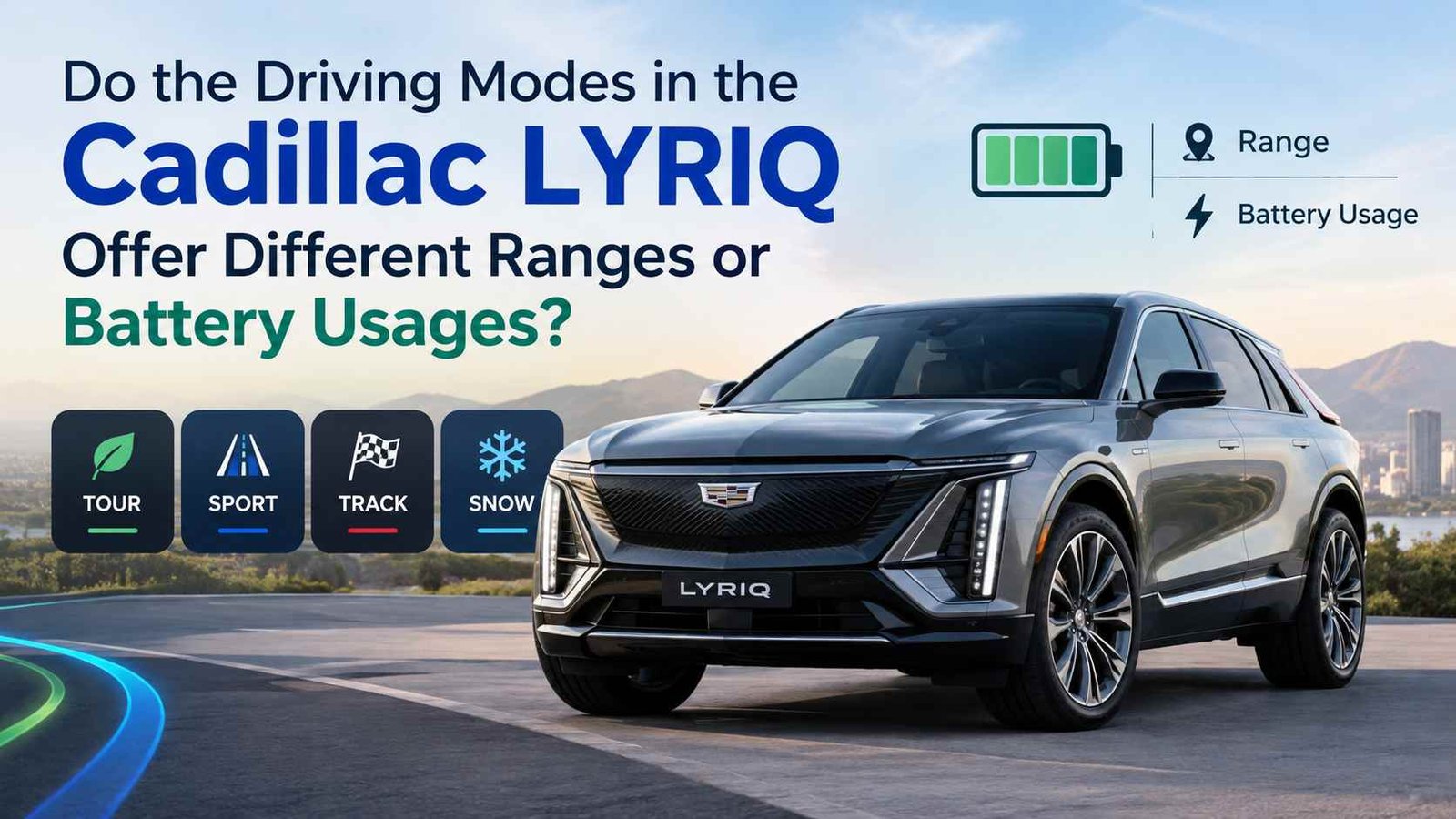
Do the Driving Modes in the Cadillac LYRIQ Offer Different Ranges or Battery Usages?
Short answer: not in the way most people expect.
Your LYRIQ’s driving modes don’t change the size of the battery, and they don’t change the EPA range on the window sticker. The pack is roughly 102 kWh whether you’re in Tour, Sport or Snow/Ice.
What they can change is how much energy the car uses per mile, mostly by changing how it reacts to your right foot.
Below, you’ll see what each mode actually does, what the real-world numbers say (and why they disagree), and which mode makes sense for your commute, your road trips and your winters.
The quick answer
Yes and no. Here’s how it breaks down:
| What | Does the mode change it? |
|---|---|
| Battery capacity (about 102 kWh) | No |
| EPA-rated range | No. It’s one figure per configuration, not per mode |
| Real-world energy use per mile | It can, mainly through pedal response and how you drive |
| Displayed range estimate | It moves with your recent driving, not with the mode label alone |
In plain terms, the mode is a setting, not a bigger tank. How you drive inside that setting usually matters more.
What each LYRIQ driving mode actually does
Cadillac’s Drive Mode Control lets you pick a mode from the touchscreen. Exact options can vary by model year and trim, so check your owner’s manual for yours.
Tour Mode: the everyday default
Tour is what the car starts in. It’s tuned for a smooth, comfortable drive with a pedal that builds power gradually.
That gentle pedal is the whole efficiency story. It makes it easy to accelerate without surging, which is what keeps consumption low in normal traffic.
Sport Mode: sharper, not magically thirstier
Sport sharpens the pedal and firms up the steering. Push the pedal and the car answers faster.
Here’s the part people miss. Sport doesn’t drain the battery by itself. It makes hard acceleration so easy and so fun that you do more of it.
Think about merging onto a highway. In Tour you might ease up to speed over ten seconds. In Sport the same pedal travel gets you there in six, and that extra power has to come from the battery.
Snow/Ice Mode: traction first
Snow/Ice softens the accelerator and manages power delivery to cut wheel slip on slippery roads. It’s a safety setting, not an efficiency setting.
If your range drops on a snowy day, don’t blame the mode first. Cold air, cabin heat, battery warm-up and winter road drag do far more damage.
My Mode: build your own
My Mode lets you adjust things like acceleration feel, brake feel, steering effort and motor sound, depending on your model year.
Set it up with a soft pedal and you get Tour-like behavior. Set it up aggressive and it behaves more like Sport. It has no built-in efficiency advantage. The result is whatever you dial in.
V-Mode on the LYRIQ-V
The performance-focused LYRIQ-V adds a burst mode for maximum power. It’s meant for short, spirited moments, not for cruising.
If you own a V, treat it like a launch button and not a daily setting.
Why the battery size never changes
The pack holds a fixed amount of energy. A mode can’t add to it or hide part of it.
What a mode changes is the rate you spend that energy. Same tank, different way of pouring.
The EPA number works the same way. It’s a standardized test result for a given model year and drivetrain, not a promise for each mode. Published figures run from about 307 to 326 miles depending on year and rear- or all-wheel drive, so check your own label.
What the real-world numbers say (and why they disagree)
Cadillac doesn’t publish a range figure for each mode. So you’ll find a lot of confident percentages online that don’t match each other.
One roundup of owner data puts Sport at roughly 5 to 15 percent less range than Tour. Another site claims 8 to 15 percent. A third says there’s no reliable universal number at all.
Here’s one concrete owner-reported example worth knowing. A driver at 70 mph reported about 2.5 miles per kWh in Tour and about 2.1 in Sport.
That’s roughly 16 percent fewer miles from every kWh. Treat it as one driver’s anecdote, not a measured rule, because it hasn’t been independently verified.
Why do the numbers vary so much? Because the tests aren’t the same test.
- Different speeds and routes
- Different temperatures
- Different drivers (a gentle Sport driver can beat a heavy-footed Tour driver)
- Different wheel sizes and drivetrains
So the honest takeaway is this. Tour is usually the most efficient starting point, Sport can cost you something if you use it hard, and the size of the gap depends heavily on you.
Run your own test (it takes about an hour)
You don’t have to trust anyone’s percentages, including ours. Here’s a simple way to get your own number.
- Pick a route of 20 to 30 miles you can repeat, ideally with some highway.
- Start each run with the same battery level and the same cabin settings.
- Reset the trip meter and note the energy-use screen.
- Drive at the same speed in one mode, then repeat in another.
- Record miles per kWh for each run, and do each mode at least twice.
Keep the weather similar, because a 20-degree swing will wipe out any mode difference.
Does the range estimate change when you switch modes?
The number on your display is a guess based on how you’ve been driving recently. It isn’t a fixed property of the mode.
So when you flip to Sport and the estimate dips a few miles, that’s mostly the car reacting to your recent driving and conditions.
Don’t judge efficiency from that estimate. Look at miles per kWh over a full trip instead. It’s far steadier.
What affects your range more than the mode
If you only fix one thing, fix speed.
Speed
Car and Driver’s highway test reported about 270 miles for a rear-drive LYRIQ against a 314-mile EPA rating. That’s a gap of roughly 14 percent from highway speed alone.
That’s bigger than most mode differences you’ll ever see.
Cold weather
Owners commonly report losing somewhere between 15 and 40 percent of range in winter, depending on temperature, trip length and heater use.
The battery has to warm up and the cabin has to stay comfortable. Both draw power.
Wheels and tires
Owner reports suggest the larger 22-inch wheels cost a few percent in efficiency compared with smaller ones. That’s anecdotal, but it matches basic physics.
Keep your tires at the recommended pressure either way. It’s free range.
Regen braking
One-Pedal Driving and the Regen on Demand paddle recover energy when you slow down. In stop-and-go traffic they can quietly improve your numbers in any mode.
Preconditioning
Warm or cool the cabin while the car is still plugged in. You start the drive with a full battery instead of spending it on comfort.
Does the LYRIQ have an Eco mode?
Not as a dedicated preset. If you’re coming from an EV with an Eco button, that surprises people.
The closest thing is Tour Mode, or a My Mode setup with a soft pedal and strong regen. Pair it with smooth driving and moderate speeds and you’ve got the same effect.
Which mode should you use? Five real-life scenarios
The daily commuter. Picture a 30-mile round trip, mostly city streets. Stay in Tour, or use a gentle My Mode, and lean on One-Pedal Driving. You’ll recover energy at every light.
The road tripper. Tour at a steady speed. Dropping from 80 to 70 mph will help you more than any mode switch.
The winter driver. Use Snow/Ice only when the road is genuinely slick. On cold but dry pavement, Tour plus preconditioning wins.
The weekend fun driver. Sport is there to be enjoyed. Use it on a good road, then switch back for the highway home.
The shopper weighing performance against efficiency. You don’t have to choose once. The car lets you pick per drive, so you can have a calm commuter on Monday and a sportier SUV on Saturday.
What the difference actually costs
Percentages are abstract. Dollars and minutes aren’t.
Take the owner-reported example above and assume electricity at 17 cents per kWh. Your rate will differ, so swap in your own.
- 100 miles at 2.5 mi/kWh uses 40 kWh and costs about $6.80
- 100 miles at 2.1 mi/kWh uses about 47.6 kWh and costs about $8.10
That’s about $1.30 more per 100 miles. Real, but small.
On a 300-mile trip, the same gap adds roughly 23 kWh of energy. If your fast-charging sessions average around 100 kW, that’s about 14 extra minutes at the charger.
The point isn’t that Sport is bad. It’s that you can now price the fun and decide for yourself.
Quick tips to stretch every charge
- Start long drives in Tour and watch your speed
- Keep your pedal inputs smooth and look ahead in traffic
- Use One-Pedal Driving or the regen paddle in stop-and-go driving
- Precondition while plugged in, especially in winter
- Check tire pressure monthly
- Save Snow/Ice for actual snow and ice
- Follow Cadillac’s charging guidance for everyday use versus trips
FAQ
Do LYRIQ driving modes change the battery’s capacity? No. The battery size is fixed. Modes change how the car delivers and uses that energy.
Which mode gives the best range? Tour is usually the best starting point. A softly tuned My Mode can match it.
Does Sport Mode drain the battery faster? It can if you use the extra response often. A gentle driver in Sport sees a smaller penalty than a heavy-footed driver in any mode.
Does Snow/Ice Mode use more battery? The mode itself has a small effect. Cold weather and heating cause most of the loss you see in winter.
Can My Mode improve efficiency? Only if you configure it for it, with a gentler pedal and strong regen.
Is Sport Mode bad for long-term battery health? Occasional Sport driving isn’t considered a battery-health concern. Charging habits and heat exposure matter more, so follow Cadillac’s guidance.
Can I change modes while driving? Check your owner’s manual for your model year before you rely on this.
The bottom line
The LYRIQ’s driving modes change how the car feels and how you tend to drive, and that can change your energy use. They don’t change the battery or the EPA rating.
Use Tour as your default, Sport when you want fun, Snow/Ice when the road is slick, and My Mode to tailor it your way.
If you’re shopping, book a test drive and flip through the modes yourself. The difference in feel is something you have to experience, and the difference in range is something you can measure.