Crackstube Decoded: One Name, Different Sites, and How to Tell
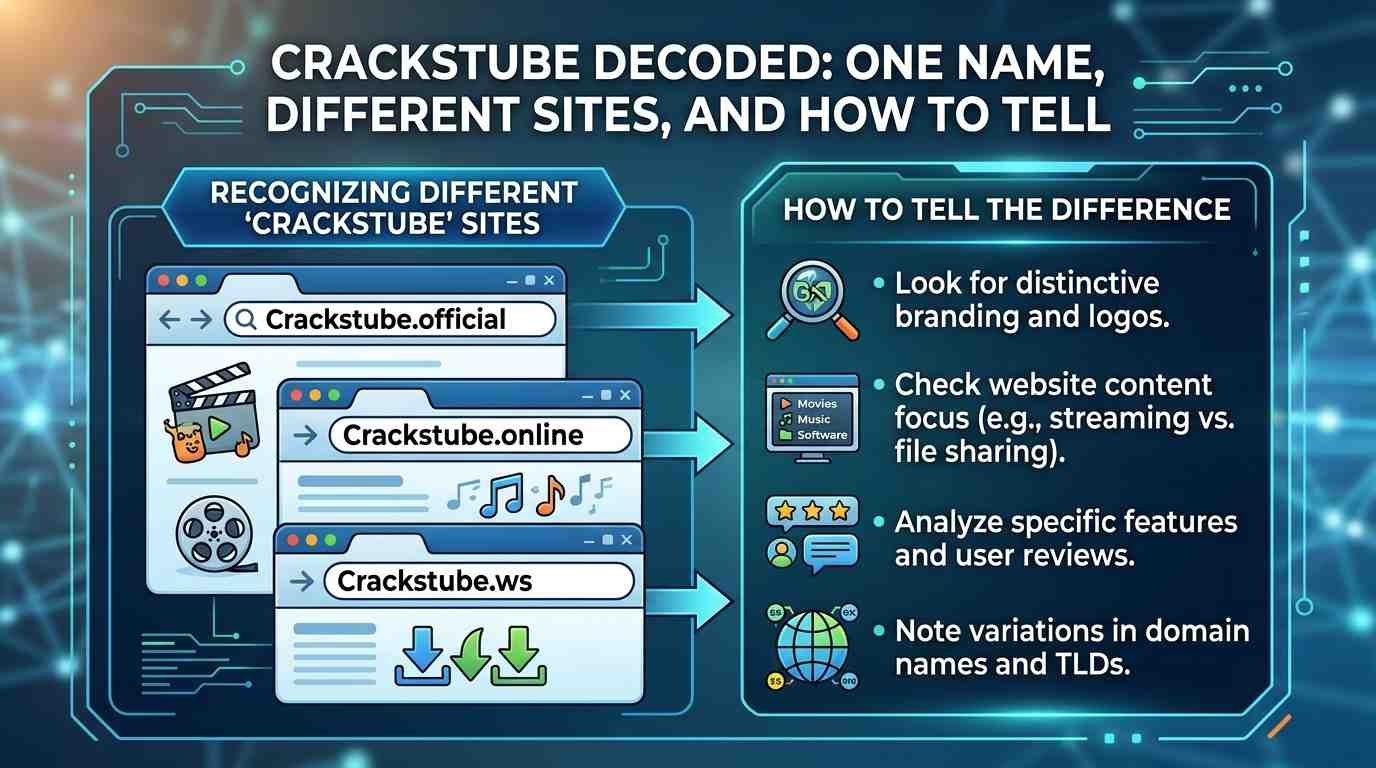
The short answer: “Crackstube” doesn’t point to one single thing. You’ll find the name used in at least two very different ways online.
- The domain crackstube.com describes itself as a digital media and publishing platform. It says it covers topics like technology, finance, education, and business, and that it welcomes guest posts.
- Separately, the term shows up in online discussions about unlicensed streaming and download sites, which carry real security and privacy risks.
- We found no public evidence that these two uses share the same owner.
- Whether a Crackstube result is safe or useful depends on the exact domain you’re on and what you’re trying to do there.
That’s the whole picture in four bullets. The rest of this guide helps you figure out which Crackstube you’ve actually run into and what to do next.
Start Here: Which Crackstube Situation Are You In?
People search this name for very different reasons. A marketer weighing a guest post has nothing in common with someone who just got hit by three pop-ups.
So skip straight to what matters to you:
| If you are… | Your real question is… | Go to |
|---|---|---|
| Curious after seeing the name somewhere | “What even is this?” | Why One Name Leads to Different Websites |
| About to visit, or already on, a Crackstube page | “Is this safe?” | The 60-Second Safety Check |
| A writer, marketer, or business owner | “Is a guest post there worth the money?” | For Marketers: Scoring a Publishing Opportunity |
| Worried after clicking a pop-up or download | “Did I just mess up my device?” | Already Clicked Something? |
| Researching for a report or article | “What’s actually confirmed?” | What We Can Confirm vs. What’s Just Repeated |
Why One Name Leads to Different Websites
Mixed search results feel suspicious. Usually, though, they have a boring explanation. Here are the five forces behind the Crackstube confusion.
- The name sets expectations before you click. “Crack” makes people think of cracked software. “Tube” makes them think of video sites. Many searchers expect a free download or streaming site before they’ve seen a single page.
- Search engines match words, not owners. Any page that uses the term can rank for it. That includes pages about the .com site, pages about other domains, and pages about a whole category of sites.
- Third-party blogs fill the gaps. When a site has a thin public profile, other websites write about it. Some get it right, some guess, and some copy each other until a guess looks like a fact.
- Lookalike domains are everywhere. A version with an extra word, a hyphen, or a different ending (.net, .co, .xyz) can exist with zero connection to the original.
- Websites change over time. Domains get sold, rebuilt, and repurposed. A description written two years ago may not match the site today.
A Quick Lesson in Ambiguous Keywords
Crackstube isn’t unusual here. Search “Mercury” and you’ll get a planet, a chemical element, a car brand, and a rock singer, all on page one.
Search “Python” and you’ll see a programming language next to a snake. Nobody assumes the snake writes code.
The takeaway is simple. Mixed results are a cue to check, not a reason to panic. The fix is the same every time: look at the exact domain and judge that site on its own.
The Two Main Meanings of Crackstube, Side by Side
Blending these two meanings together is the most common mistake people make. Let’s pull them apart.
Meaning 1: crackstube.com as a publishing site. The site presents itself as a digital media platform with guest-posting opportunities. Its self-description lists technology, finance, education, and business. Some third-party pages also report coverage of health, lifestyle, marketing, property, law, and home improvement.
Meaning 2: “Crackstube” as a label for risky streaming or download sites. Some pages online use the term to describe unverified video hubs or cracked-software sites. Those sites tend to make money from aggressive ads and redirects rather than subscriptions.
| Factor | crackstube.com (publishing site) | “Crackstube” as a streaming/download label |
|---|---|---|
| What it offers | Written articles across many topics | Videos, files, or “free” media of unclear origin |
| How it presents itself | Digital media platform, guest posts welcome | Often no clear identity or owner |
| Who usually lands there | Readers, writers, marketers | People looking for free media or software |
| Main concern | Article quality and placement value | Malware, tracking, legal exposure |
| What to check first | Author, date, sources, policies | Redirects, pop-ups, download prompts |
One point matters more than the rest: a shared name proves nothing about shared ownership. Treat these as separate until real evidence connects them.
What We Can Confirm vs. What’s Just Repeated
Articles about little-known websites often repeat each other without checking. One blog guesses, a second blog quotes the first, and suddenly the guess looks settled.
Here’s where things actually stand:
| Claim | Status | How to check it yourself |
|---|---|---|
| crackstube.com describes itself as a digital media platform | Self-described | Read the homepage and About page |
| The site accepts guest posts | Self-described | Look for a “Write for Us” or contact page |
| The site covers health, law, property, and more | Reported by third parties | Browse the category menu and recent posts |
| The site is “leading” or “high quality” | Marketing language, not independently verified | Read several articles and judge for yourself |
| Streaming or download sites using the name belong to the .com owner | No evidence found | Compare ownership details, contact info, and policies |
| Specific malware percentages tied to “Crackstube sites” | Unverified unless traced to an original report | Find the original security report, not a blog summary |
This habit works far beyond Crackstube. Next time you research any unfamiliar site, sort what you read into three piles: what the site says about itself, what others say about it, and what you can confirm.
The 60-Second Safety Check (Before You Click Anything)
“Is it safe?” depends on what you’re about to do. Reading an article is one thing. Typing your card number is a completely different decision.
Run through these six checks on any Crackstube-related page:
- Read the full address bar. Look for misspellings, extra words, hyphens, or an unfamiliar ending like .xyz.
- Watch for redirects. If the URL changed after you clicked, judge the site you’re on now, not the one you meant to visit.
- Notice the pressure. Fake play buttons, countdown timers, and “update your player” prompts are classic red flags.
- Check what it’s asking for. A site you’re only reading has no reason to want your password, payment details, or ID.
- Look for identity pages. About, Contact, Privacy Policy, and Terms should exist and actually match the site.
- Listen to your security tools. If your browser or antivirus throws a warning, leave. Don’t argue with it.
Risk Level by Action
| What you’re doing | Risk level | Why |
|---|---|---|
| Reading an article | Low | Nothing extra is exchanged beyond normal browsing |
| Clicking outbound links | Medium | The destination may not share the source’s standards |
| Playing embedded video on an unknown site | Medium–High | Fake players often trigger redirects |
| Creating an account | Medium–High | Your email and password sit on servers with unknown security |
| Downloading files or “players” | High | A common route for unwanted software to reach devices |
| Entering payment or ID details | High | Only do this on sites with a clear, verified identity |
Green Flags and Red Flags: A Simple Trust Scorecard
No single signal proves a site is good or bad. Patterns do. Use this scorecard on Crackstube or any other unfamiliar site you land on.
| Green flags (builds trust) | Red flags (slow down) |
|---|---|
| Named authors with real bios | No authors, or one generic name writing about everything |
| Clear publish and update dates | No dates, or old content passed off as current |
| Working contact details | No way to reach anyone |
| Privacy policy and terms that fit the site | Missing, copied, or mismatched policies |
| Sources linked for key claims | Big claims with nothing behind them |
| Calm layout, normal ads | Pop-ups, fake buttons, forced redirects |
| Clear categories and consistent focus | A random pile of thin, unrelated posts |
| HTTPS connection | Browser “Not secure” warnings |
A quick word on that padlock icon. HTTPS means your connection to the site is encrypted. It doesn’t mean the people running the site are honest. Plenty of scam pages have a padlock.
If a site shows mostly green flags, you can read with reasonable confidence. If red flags start stacking up, stop before you click, sign up, or download anything.
Three Real-World Scenarios, Walked Through Step by Step
Advice sticks better when you can picture it. Here’s how three common situations play out.
Scenario 1: “I Found a Crackstube Article on Google. Can I Trust It?”
Maya is comparing high-yield savings accounts. A Crackstube article ranks for her search, and it lists “the top five banks right now.”
First, she checks the address bar and confirms the domain. Next, she looks for an author name and a date. The article is 14 months old, and rates change constantly.
So she treats it as a starting list, not a final answer. She checks current rates on each bank’s official website before moving any money.
The rule: For anything involving money, health, or legal questions, use the article as a lead. Confirm the details with an official source before you act.
Scenario 2: “A Site Using the Crackstube Name Opened Pop-Ups and Told Me to Update My Player”
Jordan clicked a search result promising a free movie. Three pop-ups opened, and a message said his “video player is out of date.”
He did the right thing. He closed the tab without clicking “Allow,” “Update,” or “Download.”
Fake update prompts work because they look routine. Real software updates come from your device’s settings or the official app store. They don’t come from a random video page.
The rule: If a website tells you to install something before you can watch, leave. If you already clicked, jump to the recovery plan below.
Scenario 3: “Someone Emailed Me Offering a Paid Guest Post on Crackstube”
Priya runs a small bakery-supply shop. An email offers her a “high-authority guest post” for $120 and includes a screenshot of impressive metrics.
She doesn’t pay based on a screenshot. Instead, she asks for the full terms in writing and checks whether the site’s recent posts actually show up on Google.
She also asks a simple question: does this site publish anything related to baking? If not, the link may do very little for her business.
The rule: Score the opportunity before you spend a dollar. The next section shows you how.
For Marketers: Scoring a Crackstube Publishing Opportunity
A site that accepts guest posts is offering a place to publish. That’s all. It isn’t promising rankings, traffic, or sales, and you shouldn’t assume it is.
Topical fit often matters more than a single authority number. A link from a page about kitchen equipment helps a bakery-supply shop more than a link buried among crypto, CBD, and casino posts.
Be careful with sites that publish many unrelated sponsored posts. That pattern can mean lower value and higher risk for your brand.
The Placement Scorecard
Score each factor from 0 to 2, then add them up.
| Factor | 0 points | 1 point | 2 points |
|---|---|---|---|
| Topic match with your niche | Unrelated | Loosely related | Directly relevant category |
| Recent posts indexed in Google | Few or none | Some | Most |
| Outbound link quality | Spammy or gambling-heavy | Mixed | Clean and relevant |
| Editorial standards | None visible | Basic guidelines | Clear rules and real editing |
| Author transparency | Anonymous | Partial | Named, real contributors |
| Organic traffic trend | Declining or unknown | Flat | Stable or growing |
| Link labeling disclosed upfront | Unclear | Partial | Fully explained |
How to read your score:
- 0–5: Walk away.
- 6–9: Proceed carefully and negotiate terms.
- 10–14: Worth considering.
Questions to Ask Before You Pay
- Is the price final, and what exactly does it include?
- Will the post stay up permanently, or only for a set period?
- Will the link be marked as sponsored or nofollow?
- Can the article be edited or removed later without notice?
- Is publication guaranteed, or is the post only reviewed?
- Who owns the content once it’s live?
Get the answers in writing. A publisher that won’t put terms in writing has told you something useful.
How to Check Indexing in Under a Minute
Open Google and type site: followed by the domain, with no space. For example: site:example.com.
Then scan the results for recent posts. If articles from the past few months are missing, a new post may sit unseen too. Pages that don’t appear in search pass little value.
Already Clicked Something? A Recovery Plan
First, take a breath. Most accidental clicks don’t end in disaster. Acting quickly and in the right order does help, though.
| When | What to do |
|---|---|
| Right now | Close the tab. If a file ran, disconnect from Wi-Fi. Don’t open anything you downloaded. |
| Within the hour | Run a full scan with updated, reputable security software. Remove any browser extensions you don’t recognize. |
| Today | Change your email password first, then banking and shopping accounts. Turn on two-factor sign-in. |
| This week | Watch bank statements and login alerts. Check whether your homepage or default search engine changed. |
| Going forward | Use a trusted ad blocker. Consider a DNS filtering service that blocks known harmful domains. |
Why Email Comes First
Your email account is the master key. Password resets for almost every other account land there.
If someone gets into your email, they can reset your bank login, your shopping accounts, and your social profiles. Lock it down before anything else.
Signs Something Stuck Around
- New toolbars or extensions you didn’t install
- Searches suddenly routed through an unfamiliar search engine
- Pop-ups appearing even on trusted sites
- Your browser opening random tabs by itself
If you notice any of these, run another scan and reset your browser settings to default.
Safer Ways to Get What You Were Looking For
Most people who land on risky streaming or download pages weren’t trying to cause trouble. They wanted something free. The good news is that legal, lower-risk options cover most of those needs.
| What you wanted | A safer direction |
|---|---|
| Free movies and shows | Ad-supported legal services like Tubi, Pluto TV, and The Roku Channel |
| Paid software for free | Open-source tools like LibreOffice, GIMP, and VLC |
| Media players or codecs | Official app stores and developer websites |
| Adult content | Licensed, age-verified platforms that follow consent and record-keeping laws |
| Backlinks and exposure | Niche-relevant publications and digital PR |
LibreOffice handles documents, spreadsheets, and slideshows. GIMP covers a lot of everyday image editing. VLC plays almost any video file you throw at it. None of them cost anything, and none of them come bundled with surprises.
Common Myths About Crackstube and Sites Like It
Myth: “If it has HTTPS, it’s safe.”
Reality: HTTPS protects the connection. It tells you nothing about the honesty of the people behind the site.
Myth: “Same name means same owner.”
Reality: Similar names prove nothing. Anyone can register a lookalike domain.
Myth: “I didn’t download anything, so nothing happened.”
Reality: Reading a page is usually low risk. Still, tracking scripts on ad-heavy sites can collect browsing data in the background.
Myth: “Any guest post helps SEO.”
Reality: A link on an irrelevant or spammy site can do very little, and sometimes it does more harm than good.
Myth: “If Google ranks it, Google trusts it.”
Reality: Rankings reflect relevance signals. They aren’t a safety inspection.
Quick Glossary: Terms You’ll See Around This Topic
| Term | What it means |
|---|---|
| Domain | A website’s main address, like example.com |
| Subdomain | A section added before the domain, like blog.example.com |
| Redirect | When a page automatically sends you somewhere else |
| Drive-by download | A file that starts downloading without you clearly choosing it |
| PUP | A “potentially unwanted program” that sneaks in alongside other software |
| Guest post | An article written by an outside contributor |
| Sponsored post | A paid placement that should be labeled as such |
| Nofollow / sponsored link | Link labels that tell search engines not to treat the link as an editorial vote |
| Indexing | Whether a search engine has stored a page and can show it in results |
| Mirror site | A copy of a site running on a different address, often used after a shutdown |
Frequently Asked Questions
Is Crackstube a real website?
Yes, crackstube.com exists and describes itself as a digital media and publishing platform. The name is also used elsewhere online in unrelated ways, so always confirm the exact domain you’re on.
Why does Crackstube show up for both articles and streaming sites?
Search engines rank pages that use the word, no matter who owns them. The name also suggests “cracked” software and “tube” video sites, so people use and search it in different contexts.
Is it safe to read articles on crackstube.com?
Reading articles is generally low risk on any site with normal ads and no forced redirects. Accuracy is a separate question, so check the author, date, and sources on each article.
Can I get a virus from a site using the Crackstube name?
Simply viewing a page is usually low risk. The danger comes from fake buttons, forced downloads, and “update” prompts. If a page pushes you to install something, close it.
Are all Crackstube websites run by the same people?
We found no public evidence of that. Similar names don’t prove shared ownership, so treat each domain as its own website.
Is buying a guest post on Crackstube worth it for SEO?
It depends on topic fit, indexing, link quality, and terms. Run the placement scorecard above. A score below 6 is a good reason to walk away.
How do I report a suspicious site using this name?
You can report phishing or malware pages through Google’s Safe Browsing reporting tool. Your browser and antivirus provider usually offer reporting options too.
My browser keeps redirecting after I visited a Crackstube page. What now?
Remove unfamiliar extensions, reset your browser settings, and run a full security scan. If the redirects continue, follow the full recovery plan above.
Your Next Step, Based on Why You Came
The core idea fits in one line: check the exact domain first, then decide based on what you want to do.
- Just curious? You now know the name points to more than one thing. That’s the full answer.
- Reading an article there? Check the author, date, and sources. Confirm anything important somewhere official.
- Stuck on a pop-up-heavy site? Leave now, and follow the recovery steps if you clicked anything.
- Considering a guest post? Run the placement scorecard and get the terms in writing before you pay.
One name, several possible meanings, and a simple habit that clears up all of them.