BlackRockLast com Review: Is It Linked to BlackRock? An Investor Guide
Is BlackRockLast com connected to BlackRock?
Get the facts, a clear trust scorecard, warning signs, and a 7-step checklist to verify any financial website.
BlackRockLast com: The Essentials at a Glance
| 🔍 What You Want to Know | ✅ The Short Answer |
|---|---|
| What is BlackRockLast.com? | A website publishing health, sleep, recipe, and family wellness articles |
| Is it part of BlackRock, Inc.? | No verified affiliation found |
| Does it publish financial news or investment insights? | Not based on its visible content |
| Who owns it? | Not clearly disclosed |
| Is it a registered financial entity? | No, and it doesn’t claim to be |
| Should you use it for investment decisions? | No |
| Where does official BlackRock information live? | blackrock.com and SEC filings |
| Our overall take | A wellness site with a finance-sounding name. Verify before you trust |
Key Takeaways
- No confirmed link to BlackRock. The shared name doesn’t prove any business relationship.
- Different subject entirely. The site focuses on everyday wellness, not markets or wealth management.
- The name deserves attention. Brand-lookalike domains are a common tool in investment impersonation schemes.
- You can check any site yourself. A simple seven-step routine confirms whether a financial website is legitimate.
Why This Review Matters
BlackRock is one of the most recognized names in global finance. It manages trillions of dollars and runs the popular iShares ETF lineup.
So when a domain like BlackRockLast com appears in your search results, a link preview, or a forwarded message, it’s natural to assume a connection.
That assumption is exactly what this guide puts to the test.
Below, you’ll find a clear-eyed look at what the site is, a trust scorecard built from an investor’s perspective, real scenarios showing how lookalike domains reach people, and a verification routine you can use on any finance website from now on.
Why Investors Are Searching for BlackRockLast com
Most searches for this domain come from a place of healthy skepticism. The word “BlackRock” carries authority, and seeing it inside an unfamiliar URL makes people pause.
Here are the most common reasons readers land on this topic:
| Your Reason for Searching | The Real Question Behind It | Section That Answers It |
|---|---|---|
| You spotted the name in a link, ad, or message | Is this an official BlackRock page? | Decoding the Name |
| You expected investment content | What does the site actually publish? | Inside BlackRockLast.com |
| Someone pitched it as an “opportunity” | Could this be connected to a scam? | How Lookalike Domains Fuel Impersonation |
| You want to judge legitimacy | Who runs it, and can I trust it? | The Investor Trust Scorecard |
| You’re careful with every new finance site | How can I verify sites on my own? | The 7-Step Verification Routine |
Key point: Questioning a finance-sounding website before trusting it isn’t paranoia. It’s good investing discipline.
Decoding the Name: What “BlackRock” in a URL Really Signals
A brand name in a web address tells you what someone chose to call a website. It doesn’t tell you who owns it.
That distinction sits at the heart of this entire review.
What Is a Lookalike Domain?
A lookalike domain uses or closely resembles a well-known brand name. Some are innocent coincidences. Others are built to borrow credibility.
You can’t tell which is which from the name alone. You have to check.
Common lookalike patterns include:
- Brand + extra word: blackrock-invest, blackrockpro, blackrocksecure
- Swapped or doubled letters: blackrcok, blackrrock
- Alternate extensions: .net, .co, or .org instead of .com
- Inserted hyphens: black-rock or blackrock-funds
- Misleading subdomains: blackrock.randomsite.com, where the actual domain is “randomsite”
BlackRockLast.com follows the first pattern: a brand name with an added word. That doesn’t signal bad intent on its own. It simply means the name shouldn’t be your evidence.
Official Site vs. BlackRockLast.com
| Feature | BlackRock.com | BlackRockLast.com |
|---|---|---|
| Operator | BlackRock, Inc. | Not clearly identified |
| Primary focus | Asset management, ETFs, mutual funds, institutional services | Health and wellness articles |
| Regulatory footprint | Publicly traded (NYSE: BLK) with SEC filings | None identified |
| Investor resources | Fund fact sheets, prospectuses, research | None identified |
| Fraud guidance for users | Yes, a dedicated scams and fraud page | Not applicable |
BlackRock publicly warns people about fake websites, emails, and messages that misuse its name. Its scams and fraud page on blackrock.com is worth bookmarking if you invest in any of its funds.
Key point: A familiar name in a URL is a starting point for questions, not proof of identity.
Inside BlackRockLast.com: What the Site Actually Publishes
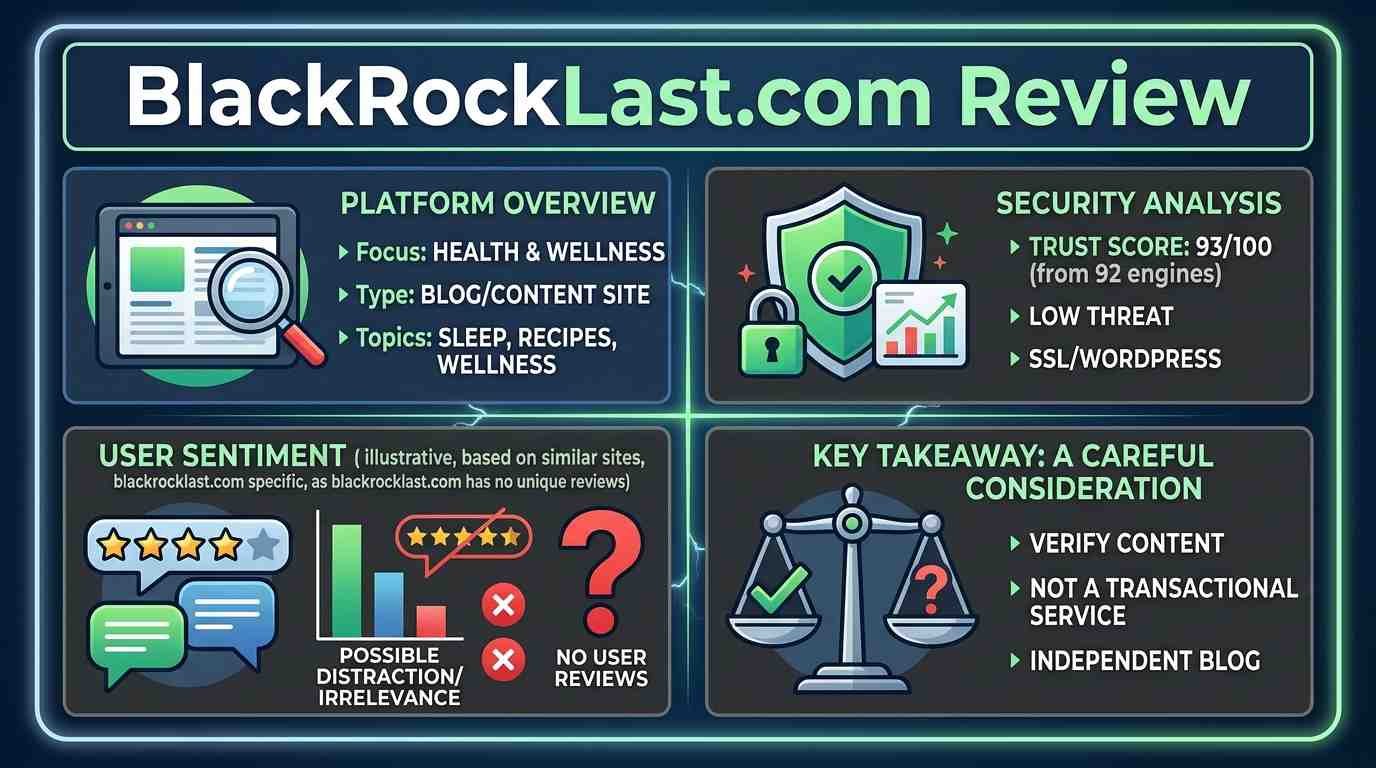
Finance-minded visitors usually feel a bit of whiplash here. Instead of market commentary, the site offers lifestyle and wellness content.
Visible content themes include:
- Healthy recipes and quick meal ideas
- Sleep habits, routines, and bedroom tips
- Family health and general well-being
Expectation vs. Reality
| What a Finance Reader Might Expect | What the Site Appears to Offer |
|---|---|
| Market trends and stock news | Recipes and meal inspiration |
| Investment insights and fund analysis | Sleep and rest guidance |
| Wealth management strategies | Family wellness articles |
| Credentialed financial writers | Author names without verified credentials |
This mismatch doesn’t suggest anyone is trying to mislead. It does confirm one practical fact: the domain name tells you nothing reliable about the site’s purpose or owner.
Key point: If you came for financial information, this isn’t the place to find it.
The Investor Trust Scorecard
Careful investors judge any source with two questions: Who’s accountable? and Can I verify it?
We applied that same lens to BlackRockLast com. Each factor gets a clear status.
| Trust Factor | Status | What It Means for You |
|---|---|---|
| Identified owner or company | ❌ Missing | You can’t confirm who’s responsible for the content |
| Verifiable author credentials | ⚠️ Partial | Names appear, but qualifications aren’t confirmed |
| Contact email and address | ✅ Present | Helpful, though still worth checking independently |
| Privacy policy and terms | ✅ Present | Standard pages exist, with fairly general details |
| Regulatory registration | ➖ None | Not a registered financial entity, and makes no such claim |
| Affiliation disclosure | ❌ Missing | No clear statement about its relationship to the BlackRock brand |
| HTTPS encryption | ✅ Present | Protects data in transit, but doesn’t prove trustworthiness |
| Third-party reputation scores | ⚠️ Mixed | Scanners have disagreed; treat scores as point-in-time snapshots |
| Domain ownership (WHOIS) visibility | ⚠️ Limited | Privacy protection is common but reduces accountability |
What the Scorecard Tells Us
The site has the basic building blocks of a working publication: contact details, policy pages, and secure browsing.
What it lacks is accountability. Without a named owner or an affiliation disclaimer, readers have no way to confirm who stands behind the content.
Key point: BlackRockLast.com works as a general content site, but it doesn’t meet the transparency bar you’d expect from any source tied to financial decisions.
Signals Worth Weighing: Caution Flags vs. Reassuring Signs
A balanced view helps you make your own call. One caution flag doesn’t make a site dangerous. Several together simply call for extra care.
| 🚩 Caution Flags | ✅ Reassuring Signs |
|---|---|
| Name closely resembles a major financial brand | No visible requests for payment or investment |
| Owner identity not disclosed | Contact page and email address listed |
| Author qualifications unverified | Privacy policy and terms published |
| Mixed third-party trust ratings | No pushy downloads or account sign-ups |
| No affiliation disclaimer | Clearly organized content categories |
Why These Flags Matter to Investors Specifically
- Brand resemblance matters because trust in a big name lowers people’s guard.
- Hidden ownership matters because financial accountability depends on knowing who’s responsible.
- No payment requests is genuinely reassuring. Impersonation schemes almost always ask for money eventually.
Three Real-World Scenarios: How Investors Encounter Lookalike Domains
Abstract warnings only go so far. Here’s how domain confusion plays out in everyday situations, and what a smart response looks like.
Scenario 1: The Search Result Mix-Up
What happens: Priya, a new ETF investor, searches for information on an iShares fund. A result containing “BlackRock” in the URL catches her eye, so she clicks.
The smart move: She notices the content has nothing to do with funds. Instead of digging around, she closes the tab and types blackrock.com directly.
Lesson: For any financial brand, go straight to the official domain rather than trusting search snippets.
Scenario 2: The “Exclusive Opportunity” Message
What happens: Marcus receives a WhatsApp message from a self-described “BlackRock advisor.” It includes a link to a site with “BlackRock” in the name and promises 15% monthly returns.
The smart move: He recognizes three warning signs at once: an unsolicited contact, a guaranteed return, and an unofficial link. He doesn’t reply and reports the message.
Lesson: Legitimate asset managers don’t recruit investors through random DMs or promise fixed profits.
Scenario 3: The Forwarded Link From a Friend
What happens: Dana’s colleague forwards a link, saying, “This looks like BlackRock’s new research portal.”
The smart move: Dana runs a quick WHOIS lookup and checks BlackRock’s official site for any mention of the portal. Neither connects the two, so she skips it.
Lesson: Even well-meaning friends can pass along misleading links. Verification takes two minutes.
How Lookalike Domains Fuel Investment Impersonation Scams
This section explains general tactics used across the internet. It does not claim BlackRockLast.com engages in any of them.
Understanding these patterns, though, protects you on every finance site you visit.
Scammers know that big financial names create instant trust. By borrowing a recognizable brand, they skip the hard work of earning credibility.
Common Impersonation Tactics
- Fake “exclusive” funds offering guaranteed or unusually high returns
- Social media and messaging groups posing as company representatives
- Cloned websites that copy logos, colors, and page layouts
- Near-identical email domains that differ by a single letter
- Unusual payment methods like crypto wallets, wire transfers, or gift cards
- Manufactured urgency such as “only 10 spots left” or “offer ends tonight”
Real Firm vs. Impersonator: How to Tell the Difference
| Situation | Legitimate Asset Manager | Impersonator |
|---|---|---|
| How they contact you | Official channels and verified domains | Unsolicited DMs, texts, lookalike emails |
| Return promises | Discloses risks; never guarantees results | Promises fixed or guaranteed profits |
| Payment process | Through regulated brokers or custodians | Crypto, wires, or gift cards |
| Pace | No pressure to act immediately | “Act now” deadlines |
| Documentation | Prospectuses, fact sheets, SEC filings | Vague PDFs or nothing at all |
Beginners tend to be the most exposed. They’re less familiar with official channels and more likely to trust a famous name at face value.
For a deeper look, see our guide on common investment scam tactics.
Key point: Any “opportunity” that combines a big brand name, guaranteed returns, and pressure to pay quickly deserves a hard pass.
The 7-Step Verification Routine for Any Financial Website
This is the most useful part of the guide. Save it, screenshot it, or bookmark it. It works on any finance site, not just this one.
- Type the official address yourself. Never rely on links from ads, emails, or messages.
- Check regulatory registration. Search the firm on FINRA BrokerCheck or Investor.gov to confirm it’s registered.
- Review SEC filings. Public companies file with the SEC on EDGAR. Confirm the website listed there matches the one you’re visiting.
- Run a WHOIS lookup. This shows when a domain was registered and, sometimes, who owns it. Brand-new domains using big names deserve extra scrutiny.
- Inspect the About and Contact pages. Look for a named legal entity, a physical address, and identifiable leadership.
- Cross-check the brand’s fraud page. Many financial firms list official contact methods and known fake sites.
- Compare multiple reputation scanners. Different tools reach different conclusions. Look for patterns, not a single score.
Free Tools That Make Verification Easy
| Tool | What It Checks | Best Used For |
|---|---|---|
| FINRA BrokerCheck | Broker and firm registration | Confirming a firm or advisor is legitimate |
| Investor.gov | Adviser records and scam alerts | Checking adviser history and warnings |
| SEC EDGAR | Public company filings | Matching company details to official websites |
| WHOIS lookup | Domain age and registrant info | Spotting new or anonymous domains |
| Website reputation scanners | Malware and trust signals | Quick technical safety checks |
Want a more detailed walkthrough? Read our step-by-step guide on how to verify a financial website.
Where to Find Real BlackRock and Market Information
If you came looking for genuine investment content, here’s where to go instead.
| What You Need | Where to Find It |
|---|---|
| BlackRock fund data and company news | blackrock.com |
| iShares ETF details | The iShares section of BlackRock’s official site |
| Official financial filings | SEC EDGAR |
| Broker or adviser background | FINRA BrokerCheck |
| Investor education and scam alerts | Investor.gov |
| Market news and analysis | Established financial outlets with clear editorial standards |
Quick Tips for Judging Financial News Sources
- Check the byline. Credible outlets name their writers and list their expertise.
- Look for corrections policies. Reputable publishers fix mistakes publicly.
- Watch for conflicts of interest. Good sources disclose sponsorships and affiliations.
- Separate news from promotion. Be wary of “news” that pushes a specific product.
Learn more in our guide to judging financial news credibility. If you’re still building your foundation, our key investing terms explained glossary is a great place to start.
Your Next Move: A Quick Decision Guide
Your best next step depends on why you landed here.
| Your Situation | Recommended Action |
|---|---|
| You just want wellness tips | Browse casually and confirm health claims with reputable medical sources |
| You expected BlackRock investment content | Leave and type blackrock.com directly |
| Someone sent this link with an investment offer | Don’t engage; verify the sender and the offer independently |
| You shared personal or financial details on a suspicious site | Follow the damage-control steps below right away |
| You’re a beginner building safe habits | Save the 7-step routine and use it on every new finance site |
Key point: When in doubt, verify first. That single habit prevents most online investment losses.
Already Clicked or Shared Details? Damage-Control Steps
If you think you’ve interacted with a lookalike site or a fake “advisor,” act calmly and quickly. Speed limits the damage.
Take these steps in order:
- Stop all contact and don’t send any more money.
- Call your bank or brokerage to flag, pause, or reverse suspicious transactions.
- Change your passwords and turn on two-factor authentication.
- Report the incident to the FTC at ReportFraud.ftc.gov and to the FBI’s Internet Crime Complaint Center (IC3).
- Notify the impersonated brand through its official fraud reporting channel.
- Monitor your credit and statements closely for the next several months.
Strengthening your defenses ahead of time helps too. Explore our guide to protecting your portfolio from risk.
Investor FAQs About BlackRockLast com
Is BlackRockLast com owned by BlackRock, Inc.?
There’s no verified affiliation between BlackRockLast.com and BlackRock, Inc. The two sites cover entirely different subjects. BlackRock’s official home is blackrock.com, and it’s the only place to get authentic company and fund information.
Does BlackRockLast.com offer investment advice or financial news?
Not based on its visible content. The site publishes wellness topics like recipes, sleep habits, and family health. It doesn’t present itself as a financial platform, and it isn’t a registered financial entity.
Is BlackRockLast com a scam?
There’s no verified evidence of fraud. However, the site doesn’t clearly identify its owner, and its name resembles a major financial brand. That combination calls for reasonable caution, not alarm.
Is it safe to enter personal information on BlackRockLast.com?
The site doesn’t appear to require personal financial details for browsing. As a general rule, avoid entering sensitive information on any website whose owner you can’t identify.
How can I tell if a financial website is real?
Type the official address yourself, confirm registration on FINRA BrokerCheck or Investor.gov, and match the domain to the company’s SEC filings. Our seven-step routine above covers the full process.
What is BlackRock’s official website?
BlackRock’s official website is blackrock.com. Its iShares ETF information is also available through the official BlackRock domain.
What should I do if I clicked a suspicious investment link?
Don’t enter any information, close the page, and run a security scan on your device. If you shared details or sent money, contact your bank right away and report the incident to the FTC and IC3.
Final Verdict on BlackRockLast com
BlackRockLast com is a wellness-focused website with a finance-sounding name, limited ownership transparency, and no verified connection to BlackRock, Inc.
It may be fine for casual reading about recipes or sleep. But it isn’t a source for investment insights, market trends, or wealth management guidance.
The bottom line:
- ✅ Fine for casual wellness browsing
- ❌ Not suitable for investment research or financial decisions
- ⚠️ Always verify any website that borrows a major financial brand name
The bigger lesson reaches well beyond one domain. A trusted name in a URL proves nothing on its own, so make verification your default.
Save the seven-step routine, and use it the next time a financial website feels even slightly off.