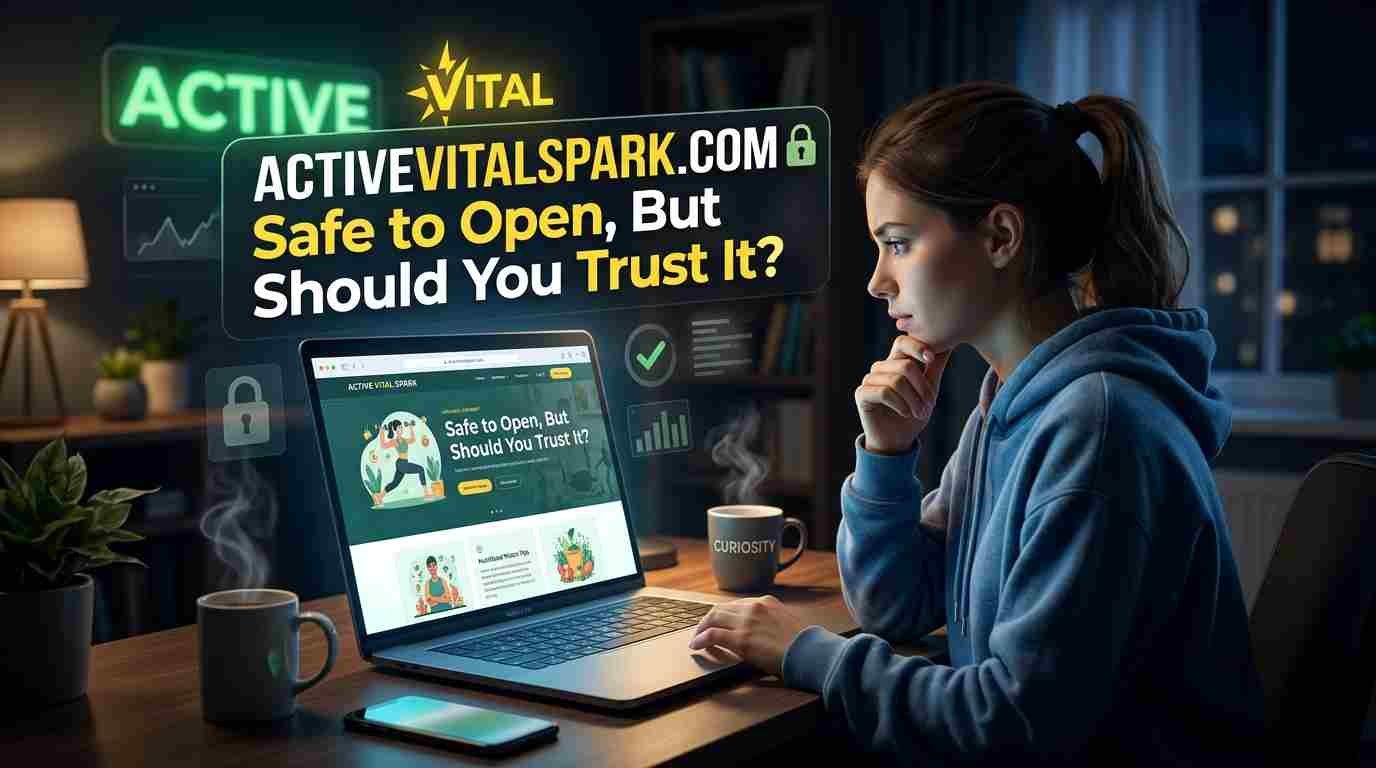
ActiveVitalSpark.com: Safe to Open, But Should You Trust It?
Search for activevitalspark com and you’ll notice something odd. The first page is packed with reviews about the site, and most of them say nearly the same thing.
They call it beginner-friendly, note that it uses HTTPS, and remind you it’s “not a substitute for professional advice.” Then they wrap up.
Here’s the problem. A site can be perfectly harmless to open and still publish advice you shouldn’t act on. Those are two separate questions, and most reviews only answer the first one.
This guide gives you a straight verdict first. Then it hands you a method you can use on this site and on any unfamiliar site you find later.
What you’ll get from this guide:
- A 30-second verdict on what ActiveVitalSpark.com appears to be and how far to trust it
- A 10-minute trust audit you can run on any single article
- A topic risk map that shows where the site can help and where you should look elsewhere
Information reflects publicly available reports as of October 2026. Details on the live site can change, so confirm anything important directly.
The 30-Second Verdict
ActiveVitalSpark.com appears to be a young, free, multi-topic content site. It leans mainly toward wellness, fitness, nutrition, and lifestyle, with occasional posts on tech, business, and money.
It’s fine for casual reading and fresh ideas. It isn’t a source to act on for health or financial decisions unless you check those claims somewhere more authoritative first.
| Question | Short Answer |
|---|---|
| Is it a real, working site? | Reports describe a functioning WordPress-style blog |
| Is it safe to browse? | No widely reported malware or phishing issues; normal caution applies |
| Who writes the content? | Not clearly disclosed in available reports |
| Is it free? | Reported as free to read, with no signup required |
| Good for medical or money decisions? | No. Treat it as a starting point only |
| Best use | Casual reading and topic discovery |
That’s the short answer. The rest of this guide explains why, and shows you how to judge any specific article yourself.
Why Your Search Shows More Reviews Than the Site Itself
Before you judge ActiveVitalSpark.com, you need to understand the search results you’re reading. Most of what you see isn’t the site. It’s other sites talking about it.
What the Results Page Looks Like
Several unrelated websites published “complete guide” or “is it legit” posts about this domain within a few months of each other in 2026. Many of them follow the same section order and repeat the same phrases.
You’ll keep running into lines like:
- “Beginner-friendly, jargon-free writing”
- “Secured with HTTPS”
- “Not a replacement for professional medical advice”
- “A convenient one-stop wellness resource”
Some of these posts even sit on sites known mostly for puns, pickup lines, or calculators. That’s a strong hint about what’s driving them.
Why This Keeps Happening
New domain names often have little competition in search. That makes them easy targets for content sites hunting quick rankings and ad revenue.
AI writing tools speed the whole thing up. One writer can produce a passable “review” in minutes, which explains why so many of them sound alike.
What It Means for You
Ten reviews saying the same thing are not ten confirmations. They may be one idea copied ten times.
So don’t measure trust by volume. Measure it by evidence, and go to the source.
Signs a review is recycled:
- No date, or a vague “updated” stamp with no detail
- No specific page references, such as article titles, menu names, or screenshots described
- A generic author name, or no author at all
- The same section order as every other result
- Confident claims with no proof, like “readers love it” or “highly trusted”
One review even claimed a two-week hands-on test with precise speed scores. Without evidence you can check, a number like that is just decoration. Treat specific stats in unknown-site reviews with healthy suspicion.
Safe, Legit, and Trustworthy Are Three Different Questions
This is the core idea of the whole guide. Most reviews blur these words together, and that’s where readers get misled.
- Safe means the site won’t harm your device or steal your data.
- Legit means it’s a real, working site, not a scam or empty placeholder.
- Trustworthy means its content is accurate, sourced, and someone is accountable for it.
A padlock icon tells you the connection is private. It tells you nothing about whether the words on the page are true.
HTTPS encrypts the traffic between your browser and the server. That’s useful, but scam sites use HTTPS too, because free certificates are easy to get.
| Layer | What It Means | How to Check | Where ActiveVitalSpark Stands |
|---|---|---|---|
| Safe | Won’t harm your device or data | Padlock icon, browser warnings, security scanners | No widely reported issues |
| Legit | A real site, not a scam | Working pages, steady publishing, no bait-and-switch | Appears to function normally |
| Trustworthy | Accurate, sourced, accountable content | Named authors, credentials, citations, editorial policy | Unproven, with limited transparency |
Two out of three is fine for browsing. It isn’t enough for decisions.
What’s Confirmed, What’s Reported, and What’s Still Unknown
Instead of another “What is it?” summary, here’s an honest evidence ledger. It separates what you can check yourself from what other people claim and from what nobody seems to know.
The Evidence Ledger
| Detail | Status | What to Do |
|---|---|---|
| Domain loads over HTTPS | Widely reported | Look for the padlock when you visit |
| Free to read, no account needed | Widely reported | Watch for new paywalls or signup prompts |
| Main topics: wellness, fitness, nutrition, lifestyle | Widely reported | Check the menu yourself |
| Extra topics: tech, business, finance, automotive, education | Reported by some reviews | Confirm what’s in the live navigation |
| Built on WordPress | Reported | Matters little for trust |
| Uses Cloudflare infrastructure | Reported by one review | A technical detail, not a quality signal |
| Named authors with credentials | Limited or unclear | Look for bylines and bios |
| Editorial or corrections policy | Not established | Check the footer and About page |
| Owner or operating company | Unknown | Don’t assume |
| Privacy policy details | Not independently confirmed | Read it before sharing anything |
The Inconsistent History
Reviews don’t fully agree on what this site is. Some describe a focused wellness platform. Others describe a general-interest blog covering everything from finance to cars.
One review also reported that older pages on the domain carried unrelated content before the site settled on health and lifestyle. That kind of pivot is common for newer domains testing which topics bring traffic. It isn’t proof of anything bad, but it’s a reason to judge each article on its own.
Another review reported that the homepage blocked automated access with a “403 Forbidden” error. That usually means the server filters bots. It doesn’t mean the site is broken for regular visitors.
Don’t Confuse It With Similar Names
Plenty of brands use words like “Active,” “Vital,” or “Spark.” Similar names don’t mean shared ownership.
Before you apply any review to a site, check the full web address letter by letter. A review of one “Spark” brand tells you nothing about another.
The 10-Minute Trust Audit: Run It on Any Article
This is the most useful tool in this guide. It works at the article level, not the site level.
That matters. One great post doesn’t vouch for the whole site, and one weak post doesn’t condemn it.
The Seven Steps
- Find the byline (1 min). Is there a real name? A short bio? Credentials that fit the topic, like a registered dietitian writing about nutrition?
- Check the date (30 sec). When was it published or updated? Old advice on supplements or tax rules can go stale fast.
- Follow two links (3 min). Do the sources exist? Do they actually say what the article claims they say?
- Test one key claim (3 min). Pick the most important claim and search it on a trusted source, such as a government health library.
- Scan for hype words (1 min). Watch for “cure,” “guaranteed,” “melt fat fast,” or “doctors don’t want you to know.”
- Look at the ads (30 sec). Does a supplement article sit next to ads for that exact supplement? That doesn’t prove bias, but it’s worth noticing.
- Check the About page (1 min). Is a real person or company accountable for what gets published?
The Trust Scorecard
Copy this table into your notes and score any article in a couple of minutes.
| Check | 2 pts | 1 pt | 0 pts |
|---|---|---|---|
| Author | Named, with relevant credentials | Named only | None |
| Date | Within 12 months | Older, but dated | Undated |
| Sources | Primary sources that check out | Secondary links | None |
| Claim test | Matches trusted sources | Partly matches | Contradicts them |
| Language | Measured and specific | Some hype | Miracle claims |
| Transparency | Clear About and contact info | Partial | Nothing |
How to read your score:
- 10–12: A solid starting point. Still verify anything high-stakes.
- 6–9: Useful for ideas. Check the specifics before you act.
- 0–5: Read it for curiosity, then move on.
Topic Risk Map: Where the Site Can Help and Where It Can’t
Not all advice carries the same stakes. A tip about laying out your clothes the night before needs far less proof than a tip about magnesium doses.
Search engines have a name for the high-stakes kind: “Your Money or Your Life” topics. In plain words, these are subjects where bad advice can cost you your health, your money, or your safety.
| Topic on the Site | Risk Level | How to Use It |
|---|---|---|
| Motivation and productivity | 🟢 Low | Try freely and keep what works |
| General lifestyle routines | 🟢 Low | Great for fresh ideas |
| Beginner fitness tips | 🟡 Medium | Fine for healthy adults; ask a pro if you have an injury or condition |
| Sleep and stress habits | 🟡 Medium | Good overview; ongoing problems need a professional |
| Tech how-tos | 🟡 Medium | Check against the product maker’s official help pages |
| Nutrition and diet changes | 🟠 Elevated | Cross-check with official dietary guidelines |
| Supplements and dosages | 🔴 High | Never act on this alone |
| Mental health concerns | 🔴 High | Use for awareness only; reach out to qualified support |
| Finance and investing | 🔴 High | Learn the terms here, then verify with regulated sources |
Here’s a quick way to apply this. The higher the risk color, the more steps of the trust audit you should actually complete before acting.
Green, Yellow, and Red Flags at a Glance
Screenshot this section. It works on almost any unfamiliar content site.
🟢 Green flags (reassuring)
- Loads securely with no browser warnings
- Free to read with no forced signup
- Plain, readable writing
- Content sorted into clear categories
🟡 Yellow flags (worth noting)
- Few or no named authors
- Broad topic spread with no clear specialty
- Limited ownership and editorial information
- A young domain with a short track record
🔴 Red flags (what to watch for)
- Specific health claims with no sources
- Miracle or “guaranteed results” language
- Product pitches woven into the advice
- Requests for personal, medical, or payment details
Based on available reports, ActiveVitalSpark.com shows the green and yellow flags above. The red flags are a watch list for any article you read, not accusations against this site.
A Worked Example: Reading a Wellness Post the Smart Way
Let’s put the audit to work. The article below is a hypothetical example, built to show the method. It isn’t a real post from the site.
Imagine you land on a post called “5 Morning Habits for All-Day Energy.” It suggests drinking water on waking, getting outside light, a short walk, a protein-rich breakfast, and a daily B-vitamin supplement “to boost energy naturally.”
Walking Through It
| Step | What You Might See | What It Means |
|---|---|---|
| Byline | “By Admin” | 0 pts. No one is accountable |
| Date | Published three months ago | 2 pts. Recent enough |
| Sources | No links at all | 0 pts. You can’t check anything |
| Claim test | Water, daylight, walking, and protein line up with mainstream health guidance | 1 pt. Most of it holds up |
| Language | Mostly calm, but “boost energy naturally” on the supplement | 1 pt. A little hype |
| Transparency | About page exists but names no people | 1 pt. Partial |
Total: 5 out of 12. That puts it in the “read for curiosity” range.
What You Can Use and What You Can’t
The low-risk habits are fine to try today. Drinking a glass of water, stepping outside, and taking a short walk carry almost no downside for most people.
The supplement tip is different. B-vitamins can interact with some medications, and most people with a balanced diet don’t need extra. That’s the one piece to run past a pharmacist or doctor before buying anything.
Notice what happened there. You didn’t throw out the whole article, and you didn’t swallow it whole. You kept the safe parts and flagged the risky one.
Who Will Get Real Value From ActiveVitalSpark.com
The honest answer is “some readers, for some things.” Here’s how that breaks down.
| Reader Type | Good Fit? | Why |
|---|---|---|
| Casual browser looking for ideas | ✅ Yes | Easy, free, varied reading |
| Wellness beginner | ✅ With care | Good for basics and vocabulary; verify specifics |
| Student researching a topic | ⚠️ Limited | Not citable; use it to find better sources |
| Experienced fitness enthusiast | ⚠️ Limited | Likely too general to add much |
| Someone managing a health condition | ❌ No | Needs personalized, qualified guidance |
| Someone making a money decision | ❌ No | Needs regulated, official sources |
If you’re in the first two rows, enjoy it as a source of ideas. If you’re in the last two, your time is better spent elsewhere.
When to Close the Tab and Go Elsewhere
Some questions are too important for any anonymous blog. ActiveVitalSpark.com is general reading, not medical or financial advice, and it shouldn’t be your source for:
- Diagnosing symptoms
- Starting, stopping, or combining medications or supplements
- Managing a chronic condition like diabetes or high blood pressure
- A mental health crisis
- Investment, tax, or debt decisions
- Anything urgent
Better Sources by Need
| If You Need… | Go To |
|---|---|
| Reliable health information | MedlinePlus from the U.S. National Library of Medicine, or major medical centers |
| Public health guidance | The Centers for Disease Control and Prevention (CDC) |
| Nutrition specifics | A registered dietitian or the official Dietary Guidelines for Americans |
| Financial guidance | A licensed advisor or the Consumer Financial Protection Bureau |
| Tech instructions | The product maker’s official documentation |
| Scam or fraud concerns | The Federal Trade Commission’s consumer advice pages |
MedlinePlus also has a free guide on judging health websites. It pairs nicely with the trust audit above.
Browsing Safely: A Quick Privacy Check
HTTPS protects your connection, but your privacy depends on more than that. Free content sites usually pay their bills with ads, and ads often come with tracking cookies.
What to Look for in a Privacy Policy
A useful privacy policy answers a few plain questions:
- What does the site collect? Things like your IP address, device type, or email if you sign up.
- Who else gets it? Ad networks and analytics tools are common.
- How long is it kept? Good policies give a timeframe.
- How can you ask for deletion? There should be a clear contact method.
If you can’t find a privacy policy at all, treat that as a yellow flag.
Simple Habits That Protect You
- Check the URL spelling before you click anything
- Decline unneeded cookies when the site gives you a choice
- Never enter health history, passwords, or payment info without a clear reason
- Skip surprise downloads and browser extensions
- Use a content blocker if pop-ups or redirects get aggressive
These habits take seconds and work on every site you visit.
What Would Make ActiveVitalSpark.com More Trustworthy
Young sites can earn trust over time. Think of this as a watch list, not a takedown.
If the site adds these, its credibility goes up fast:
- ☐ Named authors with short bios
- ☐ Health content reviewed by a qualified professional
- ☐ A visible editorial and corrections policy
- ☐ Links to primary sources, like studies or official guidelines
- ☐ Clear ownership and real contact details
- ☐ “Last updated” dates on every article
Check back in six to twelve months. If several boxes get ticked, the site deserves a fresh look.
Quick Answers to the Questions Readers Still Have
Does HTTPS mean the advice on ActiveVitalSpark.com is accurate?
No. HTTPS only encrypts the connection between you and the server. It says nothing about who wrote the content or whether it’s correct.
Why can’t I find out who writes the articles?
Many newer sites skip author bios or use generic bylines like “Admin.” It isn’t proof of a problem, but it means nobody is publicly accountable for the advice.
Why do so many websites review ActiveVitalSpark.com?
New domain names are easy to rank for, so content sites pile on to grab search traffic. That’s why many reviews look and sound alike.
Is ActiveVitalSpark.com an AI-generated site?
There’s no verified answer, so be careful with anyone who claims to know. You can judge for yourself: look for repetitive phrasing, missing authors, and claims with no specific details or sources.
Can I cite ActiveVitalSpark.com for school or work?
It’s not a good choice. Without named authors or sources, most teachers and editors won’t accept it. Use it to discover a topic, then cite the original research or official source instead.
Is it connected to other “Vital Spark” websites?
No verified connection has been reported. Similar names alone don’t mean shared ownership, so always check the exact URL.
Is it free, and will that change?
Reports say it’s free with no signup. Free sites sometimes add paywalls or memberships later, so check the current terms when you visit.
The Bottom Line
ActiveVitalSpark.com looks harmless to browse and unproven as an authority. That makes it a decent place for casual ideas and a weak place for decisions about your health or your money.
The bigger win is what you’re walking away with. You now know the difference between safe, legit, and trustworthy, and you have a 10-minute audit that works on any article from any site.
Your next step is simple. Open the next unfamiliar wellness article you find, run the scorecard, and see how it holds up. The padlock gets you in the door. Your own judgment decides what you take home.