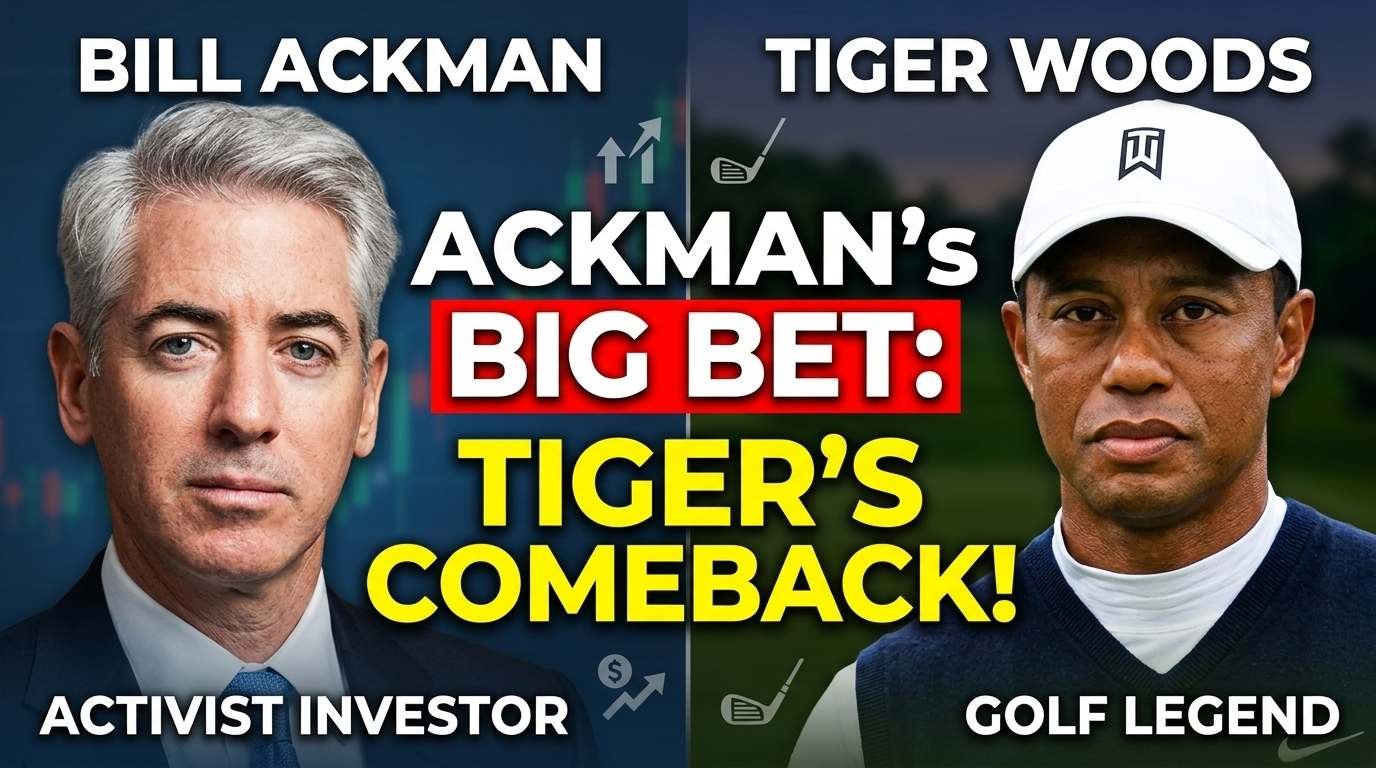
Tiger Woods and Bill Ackman: The Real Nike Connection, Fact vs. Speculation
Tiger Woods and Bill Ackman are not friends, business partners, or co-investors.
Their only verified link is Nike. Woods was the face of the brand for 27 years, and Ackman’s hedge fund, Pershing Square, bought Nike stock twice.
The bigger of those two bets came after Woods had already left.
So why do these two names keep showing up together in your search bar?
Below, you’ll get the short answer, a clean timeline, a clear split between facts and rumors, and what this odd pairing shows about how sports fame turns into Wall Street value.
The Short Answer: Are Tiger Woods and Bill Ackman Connected?
Not directly. No friendship, joint venture, co-investment, or personal investment between Tiger Woods and Bill Ackman has ever been reported.
They share one link: Nike. Woods endorsed Nike from 1996 to January 2024.
Ackman’s fund, Pershing Square, owned Nike stock from late 2017 to early 2018, then again starting in 2024.
That’s the whole relationship. Two separate roles at the same company, at different times, for different reasons.
Key Facts
- No partnership: No shared deal, company, or investment has been reported.
- Nike is the link: Woods as an endorser, Ackman as a shareholder.
- Woods left first: He split with Nike in January 2024, months before Pershing’s big buy.
- The second bet lost money: Ackman’s 2024–2025 Nike position reportedly ended in a loss of more than $600 million.
- No public business comments: Neither man has spoken about the other in any business context.
If you only needed the answer, there it is. If you want to know why it matters, keep reading. The story behind Tiger Woods’ Nike deal is more useful than the rumor.
Why Tiger Woods and Bill Ackman Are Searched Together
The pairing isn’t random, but it isn’t proof of a relationship either. A few forces push these two names into the same search results.
1. A real business overlap
Nike ties their stories together. When a golf legend’s sponsor becomes a hedge fund’s stock pick, business writers notice. That alone puts both names in the same headlines.
2. Analyst commentary in 2024
When Pershing Square disclosed its Nike stake in August 2024, some market coverage pointed to Woods and LeBron James as examples of star power Nike had lost or might lose. That was analyst opinion, not Ackman’s stated reasoning. Still, it put “Woods” and “Ackman” in the same paragraphs, and search engines took note.
3. A social media moment
Ackman reportedly shared an old clip of a teenage Woods talking about racism in golf in July 2023, praising his vision and discipline. If accurate, that was a fan-style post. It wasn’t a meeting, a deal, or a friendship.
4. How name-pair searches snowball
Autocomplete and “related searches” tend to pair names that trend at the same time. Then sites publish “X and Y” pages to catch that traffic, and many repeat each other without citing a source. The result looks like a story, even when there isn’t much of one.
5. Parallel headlines in 2025 and 2026
Both men stayed in the news at the same time. Ackman made a much-criticized pro tennis doubles debut at Newport in July 2025 and took Pershing Square public in April 2026. Woods dealt with back surgery in late 2025 and a widely covered legal case in 2026 that he resolved with a no-contest plea in September. Check court records for exact details.
Quick tip: If a page claims a “hidden connection,” look for a filing, a press release, or a named reporter. No source usually means no story. Our guide on how to fact-check celebrity business claims walks through this in more detail.
The Nike Timeline: Where Their Stories Actually Overlap
This table skips the biography filler and shows only the events where their paths cross Nike.
Tiger Woods, Bill Ackman, and Nike: Key Dates
| Date | What Happened |
|---|---|
| August 1996 | Woods turns pro and signs with Nike |
| Late 2017 | Pershing Square buys Nike, calling it a passive stake |
| Early 2018 | Pershing exits with a reported profit of about $100 million |
| January 2024 | Woods and Nike end their 27-year partnership |
| February 2024 | Woods launches Sun Day Red with TaylorMade |
| Q2 2024 | Pershing discloses more than 3 million Nike shares, about a 0.2% stake |
| Q3–Q4 2024 | The position grows sharply; Nike brings back veteran Elliott Hill as CEO |
| Early 2025 | Shares converted to call options, so the 13F shows no Nike stock |
| November 2025 | Remaining options sold at a reported loss of more than $600 million |
| Q2 2026 filing | No Nike position listed |
Notice the order. Woods walked away from Nike in January 2024. Ackman’s big purchase showed up months later. He wasn’t buying Tiger. He was buying a company that no longer had Tiger.
One more detail trips people up. That early 2025 filing made it look like Ackman sold out. He didn’t, at least not right away. He swapped shares for options, which don’t appear the same way. Here’s a simple breakdown of what a 13F filing shows and what it hides.
Did Bill Ackman Buy Nike Because of Tiger Woods?
No evidence supports that idea, and the timing argues against it.
Woods left Nike in January 2024. Pershing’s major position came in the second quarter of 2024 and grew after that. You don’t usually bet on a brand because of an athlete who just walked out the door.
Ackman’s own pitch was about the business. He described Nike as a potential large-cap consumer turnaround, pointing to its brand strength and its dominant position in footwear. The return of Elliott Hill, a longtime Nike insider, gave that Nike turnaround story a management angle.
So where does the confusion come from? Mostly from analysts who used Woods as an example of Nike’s aging star roster. That’s a fair observation about Nike. It just isn’t Ackman’s reasoning.
What about the first stake in 2017? Woods was still a Nike athlete then. But nothing ties that trade to him either. It was a short, passive position, not the kind of activist investing Ackman is famous for.
Fact vs. Speculation: What’s Verified and What Isn’t
Here’s a quick way to check what you’ve read elsewhere.
Common Claims About Tiger Woods and Bill Ackman
| Claim You May See Online | Verdict |
|---|---|
| They are friends | No public evidence |
| They are business partners | No public evidence |
| Ackman invested in Woods or his companies | No report links Pershing to Sun Day Red, TGL and TMRW Sports, PopStroke, or Full Swing |
| Ackman bought Nike because of Woods | Not supported; Woods left first |
| Ackman still owns Nike | No; remaining options sold in November 2025 |
| They’ve appeared together publicly | No joint appearance found |
Owning a stock is not investing in an athlete
This is the part most pages skip. Say you bought Nike shares in 2015. You’d own a tiny slice of the whole company: Jordan sneakers, running shoes, soccer kits, and everything else. Golf was always a small piece of that pie.
You wouldn’t get a cut of Tiger’s endorsement checks. You wouldn’t own any part of his businesses. The same goes for Ackman. Buying Nike was a bet on shoes, apparel, and management, not on any single endorser.
Errors that keep getting repeated
- The $530 million deal: Some pages say TMRW Sports sold for that amount. Reports from July 2026 point instead to Versant agreeing to buy Full Swing, the golf simulator company.
- Pershing Square’s founding year: You’ll see 2003 and 2004. The fund launched in January 2004.
- Family details: Ackman’s number of children varies by source. When details conflict, treat them with caution.
For a deeper look at the trades that shaped his reputation, see Bill Ackman’s biggest bets.
What Tiger Woods Meant to Nike’s Brand
Before Tiger, Nike was a basketball and running company that sold some golf shirts. After Tiger, it was a golf brand too.
The turning point came fast. In August 1996, Woods turned pro and signed a reported five-year deal worth about $40 million. Nike launched its “Hello World” ad campaign within days. Eight months later, he won the 1997 Masters by 12 strokes at age 21.
That win turned a big bet into a cultural moment. Kids who’d never watched golf wanted the swoosh cap Tiger wore at Augusta. Golf apparel suddenly felt mainstream, and Nike Golf rode that wave for years.
Then came the red Sunday shirt. Woods wore red in final rounds, and the red shirt with a black swoosh became one of the most recognizable looks in sports. That’s brand equity built largely on one athlete.
Over its life, the partnership’s estimated value landed somewhere between $500 million and $660 million. Treat that as an estimate, since full contract terms were never public.
The relationship also outlasted Nike’s own golf ambitions. Nike stopped making clubs and balls in 2016, yet kept Woods in its apparel for nearly eight more years. When the deal ended in 2024, Nike Golf lost its defining face.
The takeaway: an athlete’s value to a brand builds over decades and can’t be replaced overnight. You can explore more of Tiger Woods’ career highlights to see how that value stacked up.
How Investors Like Ackman Price Brand Power
Fans and investors look at the same brand and see different things. Fans see heroes, ads, and products. Investors see pricing power, profit margins, market share, and the people running the company.
Ackman’s playbook
Ackman runs a concentrated investing style. Pershing Square usually holds roughly 10 to 15 large, durable companies at a time. He’s also known as an activist investor, meaning he buys big stakes and sometimes pushes management to change course.
Why Nike looked like a bargain in 2024
By mid-2024, Nike’s stock had slumped. Sales were slowing. Newer running brands like On and Hoka were winning over customers. Then Nike changed CEOs. To a turnaround investor, that mix of a great brand and a beaten-down price looks like opportunity.
Why it didn’t work out
Here’s the real lesson. Ackman’s first Nike trade in 2017–2018 reportedly made about $100 million in a few months. His second trade reportedly lost more than $600 million, even after he used options to manage risk.
Same brand. Same investor. Opposite results. Timing and price matter as much as brand strength, and a famous logo doesn’t guarantee a good return. You can track Pershing Square’s current holdings to see where his money sits now.
This article is for information only and is not financial advice.
From Endorser to Owner: What Woods Built After Nike
While Ackman tried to price brand value from the outside, Woods kept building it from the inside. The big shift in his career is moving from paid endorser to owner.
- Sun Day Red: His apparel brand with TaylorMade, launched in February 2024. The tiger logo carries 15 stripes, one for each major.
- TGL: A tech-driven indoor golf league from TMRW Sports, co-founded with Rory McIlroy and Mike McCarley. It began play in 2025.
- PopStroke: A putting and dining entertainment chain he co-founded, with 17 locations as of March 2026.
- TGR Design: His golf course design firm.
- TGR Foundation: His education-focused charity, started in 1996.
- The Woods Jupiter: His sports restaurant in Florida.
- Full Swing: The simulator company he invested in, which Versant agreed to buy in 2026.
Why does this matter? Endorsement fees stop when a deal ends. Ownership keeps paying as long as the business grows. Sun Day Red is a clear example. After Nike, Woods didn’t just sign with another sponsor. He built a brand he partly controls.
That’s the neat mirror image here. Woods builds brand value as an insider. Ackman bets on brand value as an outsider. Read more about Tiger Woods’ business empire.
Tiger Woods vs. Bill Ackman at a Glance
Quick Comparison
| Tiger Woods | Bill Ackman | |
|---|---|---|
| Born | December 30, 1975, Cypress, California | May 11, 1966, Chappaqua, New York |
| Known for | 15 majors, 82 PGA Tour wins | Founding Pershing Square, activist investing |
| How he makes money | Endorsements, business stakes, prize money | Stake in the firm that manages Pershing’s funds |
| Estimated net worth | About $1.5 billion (Forbes, September 2026) | About $8 billion (Bloomberg, April 2026) to $14.1 billion (Forbes real-time, October 2026) |
| Nike role | Endorser, 1996–2024 | Shareholder, 2017–2018 and 2024–2025 |
Why such a wide range for Bill Ackman’s net worth? Much of his wealth sits in his firm, and its value jumped after the April 2026 public listing. Outlets also measure on different dates. The same logic applies to Tiger Woods’ net worth, since many of his holdings are private.
Frequently Asked Questions
Are Tiger Woods and Bill Ackman friends?
There’s no public evidence they are. No joint appearance, shared deal, or interview linking them has been reported. Their only documented connection is Nike, where Woods was an endorser and Ackman’s fund was a shareholder at different times. See the fact vs. speculation table for details.
Did Bill Ackman ever invest in Tiger Woods?
No. Pershing Square bought Nike stock, not a stake in Woods or any of his businesses. No report links Ackman to Sun Day Red, TGL, PopStroke, or Full Swing. Owning a sponsor’s stock is not the same as investing in the athlete.
Does Bill Ackman still own Nike stock?
No. Pershing converted its Nike shares into call options in early 2025, then sold the remaining options in November 2025 at a reported loss of more than $600 million. Its Q2 2026 filing lists no Nike position.
Why did Tiger Woods leave Nike?
Woods and Nike announced the end of their 27-year partnership in January 2024. Neither side gave a single public reason or framed it as a dispute. Woods launched Sun Day Red with TaylorMade the following month.
Why are Tiger Woods and Bill Ackman mentioned together?
Mostly because of Nike. Analyst coverage of Ackman’s 2024 Nike buy referenced Woods as a star Nike had lost. Search autocomplete and copycat “connection” articles then amplified the pairing. The full breakdown is in this section.
Has Tiger Woods commented on Ackman’s Nike investment?
No public statement from Woods about Ackman or his Nike investment has been found. Woods has stayed focused on his own ventures, recovery, and golf commitments.
The Bottom Line
Tiger Woods and Bill Ackman share one verified link: Nike. Woods spent 27 years as the brand’s face. Ackman bet on its stock twice, winning the first time and losing the second. His big buy came after Woods had already left, and there’s no friendship, partnership, or personal investment between them.
The more useful story is what their overlap shows. One man builds brand value on the course and in boardrooms he owns. The other tries to price that value from the outside. Together, they show both sides of sports business.
Curious how other athletes made the jump from endorser to owner? Explore our sports business stories, or brush up on investing basics to read the next big stock headline with fresh eyes.