
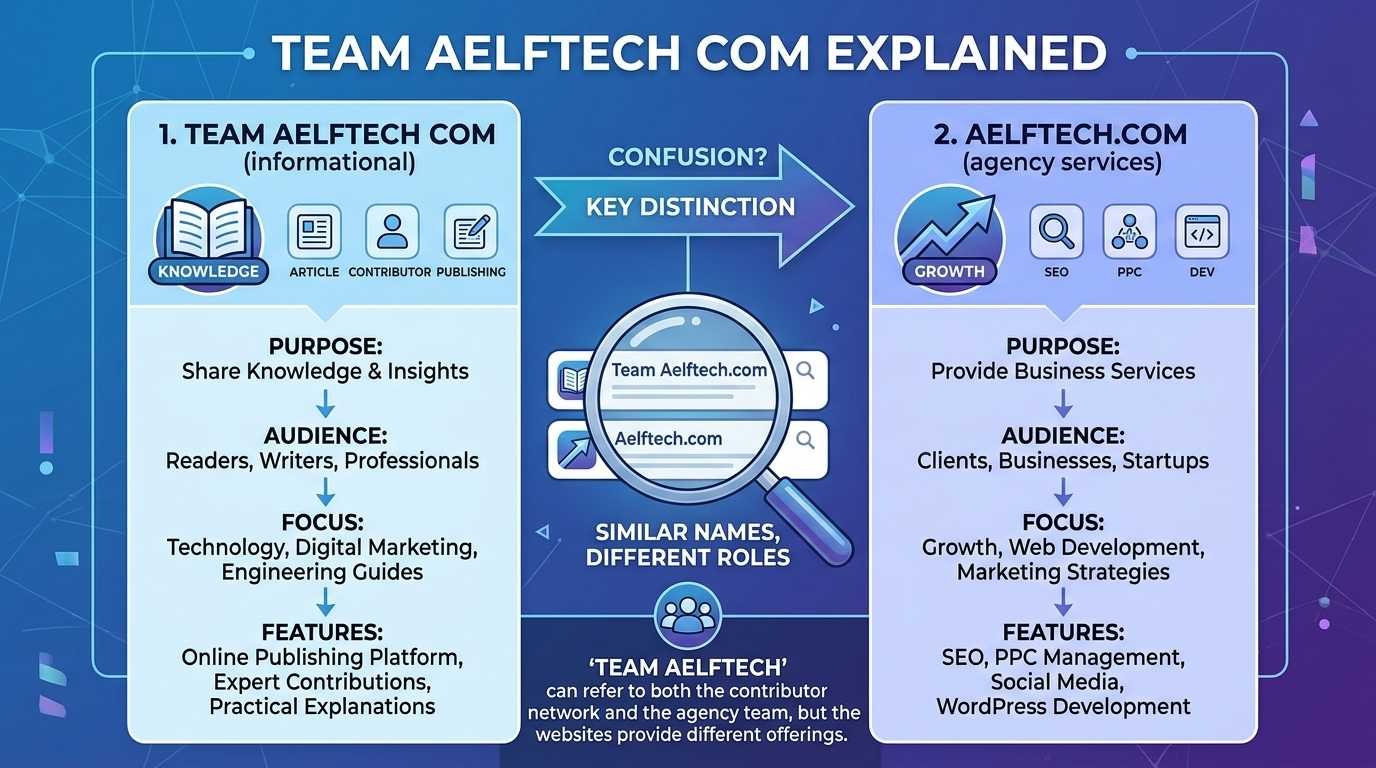
Team Aelftech Com Explained: Two Domains, One Name, Real Facts
You typed a short phrase into a search bar and got three different stories back.
One result calls it a tech community. Another describes a marketing agency. A third seems to mix both into one company.
If that’s how your search for team aelftech com went, the confusion isn’t your fault. The name connects to more than one website, and many articles blur them together.
This guide gives you three things: a fast answer, a clear way to tell the domains apart, and a simple method to check any claim yourself. No padding about generic SEO tips.
Just the facts that are publicly stated, and an honest look at what nobody has confirmed yet.
⚡ The 30-Second Answer
- TeamAelfTech.com describes itself as a knowledge hub where technology, digital marketing, and engineering professionals publish and share insights.
- Aelftech.com describes itself as a digital marketing and WordPress development agency.
- The names look alike, but public information we reviewed does not confirm they’re the same organization.
- Before you act on any claim, check which domain it actually came from.
Why One Short Search Term Produces So Many Different Answers
Before comparing the two sites, it helps to understand why the confusion exists at all. Once you see the cause, the mixed results start to make sense.
Name Collisions Happen More Than You’d Think
Similar brand names show up across different domains all the time, sometimes with no link between them. Picture a bakery called “Sunrise Bakes” and a software firm called “Sunrise Tech.” Same word, totally different businesses.
Adding “team” to a brand name shifts what search engines match. Some results lean toward TeamAelfTech.com. Others pull in pages about Aelftech.com because the core word overlaps.
How Explainer Sites Amplify the Mix-Up
Many websites publish quick explainers about trending domain names. These sites often borrow details from each other, and errors travel fast.
For example, one article might list agency services like PPC management and WordPress builds, then label the whole thing “Team Aelftech.” A reader assumes TeamAelfTech.com sells those services. It doesn’t say that it does.
Search Snippets Strip Away Context
A search result shows a title and a two-line description. It rarely tells you which domain a claim belongs to.
So you read “SEO services” in one snippet and “contributor community” in another, and your brain merges them into one picture. That’s how most mistaken assumptions start.
Three reasons your search results disagree:
- Name similarity: two domains share a core brand word
- Copy-and-paste publishing: explainer sites repeat each other’s claims
- Missing domain context: snippets don’t show which site a fact came from
Two Domains, One Name: A Side-by-Side Map
This table reflects what each site says about itself. It’s a starting point, not independent verification. If a detail isn’t clearly published, it’s marked that way.
| Factor | TeamAelfTech.com | Aelftech.com |
|---|---|---|
| How it describes itself | Knowledge hub for tech, marketing, and engineering professionals | Digital growth and marketing agency |
| Primary audience | Readers and contributors in those fields | Businesses looking for marketing or web services |
| Main activity | Publishing and sharing expertise | Selling services like SEO, PPC, social media marketing, WordPress development, and site audits |
| Main call to action | Pitch an idea or contribute | Request a free website audit or contact the team |
| Contribution model | Pitch, write and refine with editorial support, publish | Not applicable |
| Location signals | Not prominently stated | U.S. focus on the site; LinkedIn lists New York and Sydney |
| Business model | Content platform | Client services |
| Public link between them | None found in reviewed sources | None found in reviewed sources |
What the Table Tells You at a Glance
Here’s the simplest way to remember it: one site wants your writing, the other wants your business.
The calls to action reveal each site’s purpose faster than any About page. “Pitch your idea” invites writers. “Get your free audit” invites clients. Those are two very different relationships.
Reading the Clues Each Site Leaves About Itself
You don’t need special tools to figure out what a website really is. The site itself drops plenty of hints. Learn to spot them here, and you can use the same skill on any unfamiliar domain.
Homepage Language and Who It Speaks To
Words like “contribute,” “insights,” “practitioners,” and “community” signal a publishing platform. The site is talking to people who create knowledge.
Words like “grow your business,” “ROI,” “rankings,” and “free audit” signal an agency. That site is talking to people with a budget and a problem to solve.
Navigation Menus as a Map of Priorities
Look at the top menu. Category labels like AI, cloud, or engineering suggest editorial content organized by topic.
Menus with “Services,” “Case Studies,” and “Contact Us” point to a commercial operation. The menu shows you what the site cares about most.
Contact Paths and Email Domains
Check whether the contact email matches the website’s domain. An address ending in the same domain is a basic consistency signal.
Also notice the format. Does the site offer a form, a direct email, or both? A contributor platform often routes you to a pitch form, while an agency tends to push a consultation or audit request.
Five on-page clues you can check in under two minutes:
- The verbs in the main headline (contribute vs. grow)
- The top navigation labels
- The primary button text
- Whether the contact email matches the domain
- Whether pricing, packages, or audits appear anywhere
How a Contributor-Driven Knowledge Hub Actually Works
This is the part most articles skip, and it’s the key to understanding TeamAelfTech.com. A knowledge hub runs on a completely different model from an agency.
Platform vs. Agency: A Different Relationship With You
| Knowledge hub | Service agency | |
|---|---|---|
| You are a… | Reader or contributor | Client |
| Money usually flows… | Not from reader to platform | From client to agency |
| Content is… | The product | Marketing for the product |
| Quality control comes from… | Editorial review | Contracts and deliverables |
| Your main risk is… | Inaccurate information | Wasted budget or weak results |
That last row matters most. With a knowledge hub, you’re judging whether an article is accurate. With an agency, you’re judging whether a paid service delivers.
What a Typical Contribution Process Looks Like
TeamAelfTech.com describes a contributor process along these lines:
- Pitch an idea on a topic you know well
- Write and refine the piece with editorial input
- Publish it on the platform
That flow is common across contributor sites. Still, before you submit anything, read the fine print on bylines, content rights, and link policies. Our guide to guest posting guidelines explained covers the questions writers most often forget to ask.
Using the Platform as a Resource, Not a Vendor
Here’s a mistake worth avoiding. Say you read a detailed article on TeamAelfTech.com about cloud migration. That doesn’t mean the platform offers cloud migration services.
Knowledge hubs publish about topics; they don’t necessarily sell them. Treat each article as one practitioner’s perspective, and check its claims the way you would with any blog post.
Quick recap: If you’re on TeamAelfTech.com, you’re reading or writing. If you need someone to do work for you, you’re in the wrong place.
Where Does Your Search Fit? Five Reader Scenarios
Not everyone searching team aelftech com wants the same thing. Find the scenario that sounds like you and jump straight to your next step.
| If you’re thinking… | Go to |
|---|---|
| “What does this name even mean?” | The 30-second answer and domain map |
| “I want to write for them.” | Scenario 2 and the contributor questions |
| “I need marketing help.” | Scenario 3 and the hiring questions |
| “Is this article I read reliable?” | Source hierarchy and claim ledger |
| “I’m researching this for a report.” | The 10-minute verification routine |
Scenario 1: “I Just Want to Know What This Name Means”
You saw the name somewhere and got curious. You have no plans to engage.
- The 30-second answer and the comparison table cover what you need.
- No further action is required unless you decide to contribute or hire.
Scenario 2: “I’m a Writer or Engineer Thinking About Contributing”
Maybe you’re a DevOps engineer who wants to share lessons from a recent project. A contributor platform could give your work an audience.
- Review TeamAelfTech.com’s contributor information and editorial process.
- Ask about bylines, content ownership, and link policies.
- Read three or four published pieces to judge editing quality.
Scenario 3: “I Run a Business and Need Marketing Help”
Say you own a dental practice and want more local patients. You’re probably looking for Aelftech.com, not the knowledge hub.
- Request a written scope, pricing, and account ownership terms.
- Compare at least one other provider before deciding.
- Our guide on how to evaluate a digital marketing agency walks through the full vetting process.
Scenario 4: “I Saw the Name in an Article and Want to Know If It’s Reliable”
You read a blog post making claims and now you’re unsure what to believe.
- Skip ahead to the source hierarchy and claim ledger.
- Check whether the article clearly states which domain it’s describing.
Scenario 5: “I’m Researching the Brand for a Report or Review”
You need defensible facts, not impressions.
- Run the full 10-minute verification routine below.
- Record the source tier for every claim you cite.
Making Sense of Conflicting Information Online
“Verify through official sources” is common advice, but it rarely explains how. A simple source hierarchy fixes that. It tells you how much weight each type of information deserves.
A Simple Source Hierarchy
| Tier | Source type | Example | How much weight to give |
|---|---|---|---|
| 1 | The domain’s own pages | About, contact, contributor guidelines | Strong for what the site claims; not proof the claims are true |
| 2 | Company-managed profiles | LinkedIn company page, official social accounts | Useful for consistency checks |
| 3 | Independent records | Domain registration data, web archive snapshots, business registries | Strong for history and ownership signals |
| 4 | Third-party write-ups | Explainer blogs, syndicated posts | Lowest; often repeat each other |
Notice that Tier 1 isn’t the “most trustworthy” in every sense. A site is the best source for what it says about itself. It’s not a neutral judge of whether those statements hold up.
When Two Sources Disagree
Conflicts happen constantly with similar domain names. A few rules help you sort them out:
- Trust the source closest to the original. A site’s own contact page beats a blog summarizing it.
- Check the dates. An older article might describe a site before it changed direction.
- Isolate the orphans. If a detail appears only in third-party posts, treat it as unconfirmed.
Watch for the Echo Effect
Here’s the catch with online research. When five articles say the same thing in nearly identical words, that’s usually one source repeated five times, not five confirmations.
Try this: copy a distinctive sentence from one explainer and search it in quotes. If several sites share the exact phrasing, you’ve found an echo.
The Team Aelftech Com Claim Ledger: Confirmed, Company-Reported, or Unknown
This ledger sorts common statements into clear buckets. It’s the fastest way to see what’s solid and what still needs checking.
| Claim | Status | Notes |
|---|---|---|
| TeamAelfTech.com describes itself as a knowledge hub | Published by the site | Visible on the homepage |
| TeamAelfTech.com accepts contributors | Published by the site | Process described on the site |
| Aelftech.com offers SEO, PPC, and WordPress development | Published by the site | Listed on service pages |
| Aelftech.com offers a free website audit | Published by the site | Promoted through its contact process |
| Named specialists on Aelftech.com’s team | Company-reported, repeated by third parties | Not independently confirmed |
| Client results and case studies | Company-reported | Treat as marketing unless backed independently |
| New York headquarters and Sydney location | Listed on a company profile | Physical offices not confirmed |
| A business link between the two domains | Unknown | No public evidence found |
How to Read This Ledger
- “Published by the site” means the site says it. Nobody outside has necessarily checked it.
- “Company-reported” means the claim originates with the business itself.
- “Unknown” means no reliable public source settles the question either way.
None of these labels say a claim is false. They tell you how much weight to put on it, which is exactly what you need before making a decision.
Trust Signals That Matter and Ones That Only Look Reassuring
A polished website can feel trustworthy without proving much. This table separates signals with real weight from those that mostly create an impression. For a deeper list, see our guide to signs a website is trustworthy.
| Signals with real weight | Signals that prove little on their own |
|---|---|
| Consistent contact details across the site and profiles | A padlock icon (HTTPS) |
| Domain history visible in web archives | A sleek, modern design |
| Named people with matching, independent professional profiles | Stock-photo team pages |
| Clear terms of service and privacy policy | “Featured in” logos without links |
| Written scopes and contracts before payment | Guaranteed rankings or results |
| Editorial guidelines that explain review steps | A high volume of published articles |
Red Flags vs. Reasonable Gaps
Not every missing detail is a warning sign. It helps to tell the two apart.
Red flags include pressure to pay quickly, refusal to put scope in writing, or contact emails on unrelated free domains.
Reasonable gaps include a newer site with limited history or a small team with no press coverage. Gaps call for more questions, not automatic distrust.
A 10-Minute Verification Routine Anyone Can Run
This checklist works for either domain, and for any other site you’re unsure about. Set a timer and work through it.
- Confirm the exact spelling of the domain in your browser bar. “teamaelftech” and “aelftech” are different addresses.
- Read the About and Contact pages. Note the stated purpose and how the site wants you to reach out.
- Match the email domain to the website domain.
- Look up domain registration data with a public lookup tool to see the creation date and registrar. Our guide on how to check who owns a website shows you how.
- Check a web archive to see how the site looked months or years ago. Learn more in using web archives to research a site.
- Compare company profiles on professional networks for matching names, locations, and descriptions.
- Search any named people and confirm independent professional profiles exist.
- Test one specific claim against two separate sources.
- Note the source tier for everything you find.
- Write down what remains unknown so you know exactly what to ask.
A Real-World Example of Step 8
Say you want to confirm the New York headquarters listed for Aelftech.com. You check the LinkedIn company profile and find it listed there.
Next, you check the website’s contact page. It emphasizes serving U.S. clients nationwide but may not show a street address. Result: the location is company-listed, not physically confirmed. That’s a useful finding, and now you know what to ask.
Save this checklist. Run it before you contribute to, hire, or cite any site you’ve just discovered.
Questions Worth Asking Before You Engage
Once you know which site fits your goal, these questions help you avoid surprises later.
If You Plan to Contribute Content
- Who owns the article after it’s published?
- Are author bios and outbound links allowed?
- What does editorial review actually involve?
- Can you update or remove your piece later?
If You Plan to Hire Services
- What exactly is included, and what’s excluded?
- Who owns the ad, analytics, and hosting accounts?
- How are results reported, and can you see the raw data?
- What happens to your assets if the contract ends?
Our list of questions to ask before signing a marketing contract goes further, including payment terms and cancellation clauses.
Five Common Misreadings to Avoid
These errors show up repeatedly in articles about the name. Spotting them saves you from drawing the wrong conclusion.
- “TeamAelfTech.com is a software company.” It describes itself as a publishing and knowledge platform.
- “Team Aelftech and Aelftech are the same business.” No public evidence we reviewed confirms this.
- “If a site writes about a service, it sells that service.” Knowledge hubs regularly cover topics they don’t offer commercially.
- “Many articles agree, so it must be true.” Repeated claims often trace back to one original source.
- “A professional website proves legitimacy.” Design quality says nothing about ownership or track record.
Frequently Asked Questions
What is team aelftech com?
It most often refers to TeamAelfTech.com, which describes itself as a knowledge hub for technology, digital marketing, and engineering professionals. The name is sometimes confused with Aelftech.com, a separate-looking marketing agency, so always check which domain you’re reading about.
Is TeamAelfTech.com the same as Aelftech.com?
The two domains present themselves differently. One focuses on publishing professional knowledge, while the other sells marketing and development services. Public information we reviewed doesn’t establish a business connection, so treat them as separate unless new evidence appears.
Is TeamAelfTech.com an agency or a publishing platform?
Based on its own description, it’s a publishing platform. It invites professionals to share insights rather than offering a client service menu. Articles on the site cover topics like AI and engineering, but that doesn’t mean the platform sells those services.
Can I write for Team Aelftech?
TeamAelfTech.com invites technology, marketing, and engineering professionals to contribute. Its described process involves pitching an idea, refining the draft with editorial support, and publishing. Ask about content rights and link policies before submitting.
Which site should I contact for marketing services?
If you need SEO, PPC, social media marketing, or WordPress development, Aelftech.com is the domain that publicly offers those services. Request a written scope and compare at least one alternative before committing.
How can I tell if Team Aelftech is legitimate?
Run the 10-minute verification routine. Check domain history, contact consistency, independent profiles, and whether specific claims hold up across separate sources. Legitimacy is built from consistent evidence, not from a polished homepage.
Why do articles about Team Aelftech say different things?
Many explainer sites blend details from both domains and copy each other’s wording. Search snippets also remove context about which site a claim came from. Tracing each statement back to its original source clears up most conflicts.
Does Aelftech.com offer a free website audit?
Aelftech.com advertises a free website audit through its contact process. As with any free offer, ask what the audit covers and whether it comes with any obligation.
Key Takeaways
- The keyword usually points to TeamAelfTech.com, a contributor-driven knowledge hub.
- Aelftech.com is a separate-looking marketing agency with a different audience.
- Sort every claim by source: site-published, company-reported, independent, or unknown.
- Run the 10-minute routine before contributing, hiring, or citing either site.
- Your best next step depends on your goal, not on which site ranks first.
Conclusion
Searching team aelftech com doesn’t have to leave you more confused than when you started. You now know the name points to two differently positioned domains, and you have a way to tell them apart in seconds.
More useful than any single fact, you have a method. The source hierarchy, the claim ledger, and the verification routine work on any unfamiliar site you run into.
Bookmark the checklist and use it the next time a name shows up with conflicting stories. For more breakdowns like this one, browse our other domain explainers.